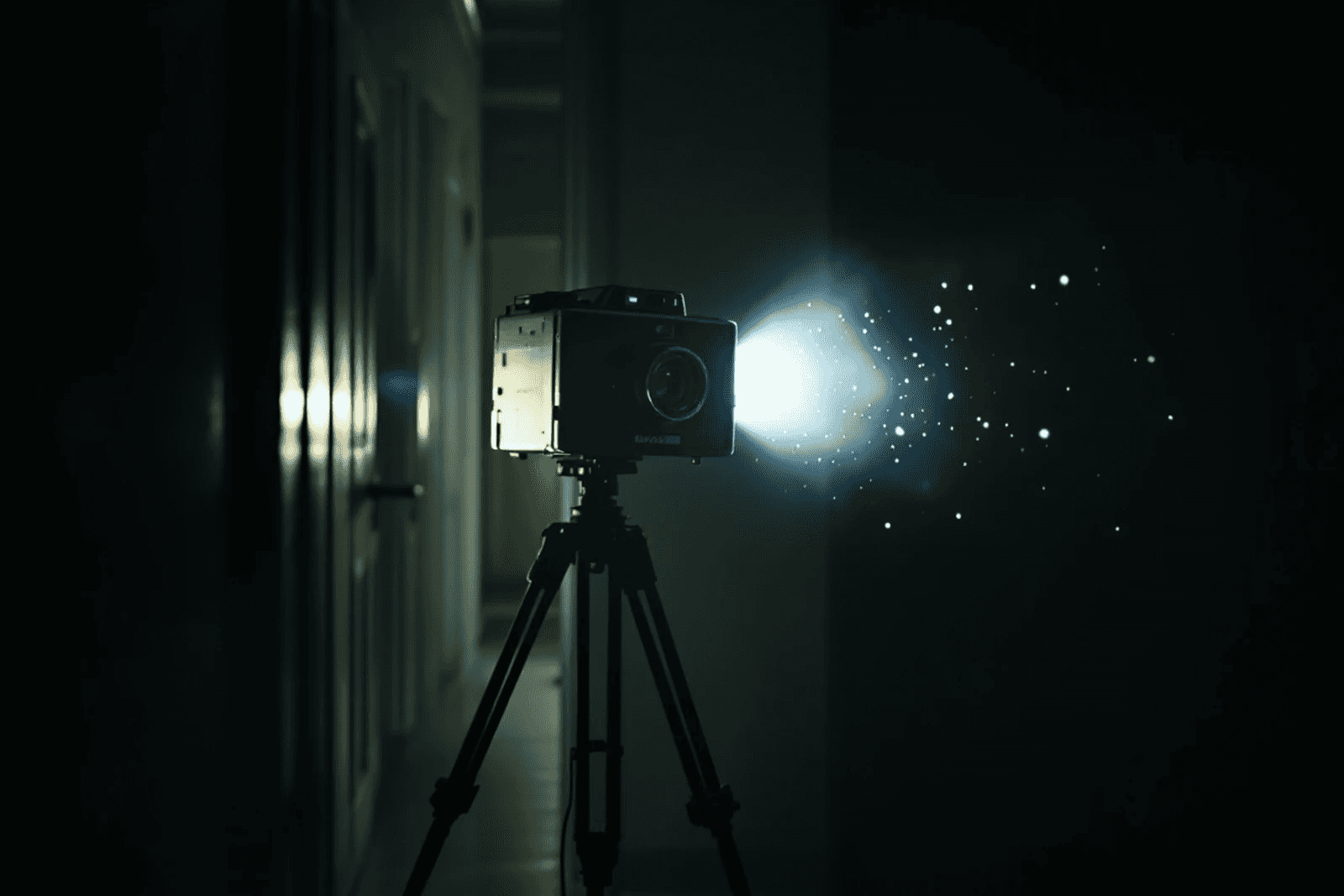
Look at the photograph before you look at the orb. A dark room, a flash, and a pale disc hanging in the air at head height, soft at the edges, as if lit from inside. The ordinary name for that disc is backscatter: the flash has lit a speck of dust, a water droplet, a grain of pollen or a small insect a few centimeters in front of the lens. The mist in the next frame is usually breath, smoke or fog. The face in the wallpaper is usually pareidolia.
None of that proves nothing happened in the room. It is the list of what has to be ruled out first, and this page goes through it in the order you would check, the same way every piece in On Camera does.
| What you see | Ordinary candidate | First check |
|---|---|---|
| A soft, glowing disc | Backscatter from dust, water, pollen or an insect near the lens | Shoot again without flash |
| A pale mist | Breath, smoke, steam or fog | Was it cold, or was anyone smoking? |
| A face in a texture | Pareidolia, which ghost hunters call matrixing | Ask someone to find the face without telling them where |
| A transparent person | Someone who moved during a long exposure | Read the exposure time in the metadata |
| A bright streak or “vortex” | A strap, hair or fingertip near the lens | Look at the edges of the frame |
| Streaks, rings or haze | Lens flare from a light outside the frame | Move the camera and see if it moves |
| A doubled or smeared figure | Night mode or HDR merging several frames | Check the exposure time; anything that moved can double |
Orbs: something small, close and out of focus
The flash fires, and everything between the lens and the subject catches its light. A mote of dust a few centimeters from the lens is far closer than anything the camera is focused on, so it does not record as a speck. It records as a blurred disc, large, soft and translucent, because it is so far out of focus that its light spreads across a wide patch of the frame.
It is also bright. Light from a flash falls off quickly with distance, so a particle almost touching the lens is lit far more strongly than the wall behind it. That is why an orb can glow in a room that otherwise looks dim.
Several orbs in one frame usually mean the air is full of something: dust stirred up by footsteps, a fine drizzle, pollen, a cloud of small insects near an outdoor light. Take a second picture a moment later and the orbs will be somewhere else, because the particles have moved.
Why phones and compact cameras see more of them
Backscatter depends on geometry. On a phone or a compact camera, the flash sits right next to the lens, so light hits a nearby particle and bounces almost straight back into the lens. A flash mounted higher, away from the lens, lights the same particle at an angle that sends much less of that light back.
Orb photographs rose with digital cameras in the late 1990s, when small cameras with built-in flashes became common. The timing is part of the evidence. The orb arrived with a particular kind of hardware.
Mist that was breath
In a cold room, the photographer’s own exhale hangs in front of the lens for a second or two, and a flash turns it into a pale veil. The same goes for someone else’s breath, cigarette smoke, steam from a drink, fog outside, or dust in a beam of light.
Ask three questions of any mist. Was it cold enough to see breath? Was anyone smoking or holding something warm? Did the photographer breathe out as they pressed the shutter? If the answer to any of them is yes, the mist has an ordinary candidate.
Faces in the texture
Pareidolia is the tendency to see faces in random texture: two dark spots and a line become eyes and a mouth. Ghost hunters have their own word for it, matrixing. It works on wallpaper, foliage, curtains, the grain of a dark photograph, the reflections in a window.
The test is simple. Show the photograph to someone without telling them where the face is. If they find the same face in the same place, note it. If they find a different one, or none, you have learned something about the picture and about the person looking at it.
Transparent people and bright streaks
In low light a camera keeps its shutter open longer. A person who walks through the frame for only part of that time registers only partly, and the wall behind them shows through. The result is a transparent figure, the same effect that spirit photographers once produced on purpose, as the story of spirit photography and the double exposure tells.
A camera strap, a loose strand of hair or a fingertip near the lens does something else. Lit by the flash and far out of focus, it becomes a bright blurred streak or a twisted band of light across the frame. In ghost-hunting circles this is often called a “vortex.” Look at the edges of the photograph for its source, and ask whether the camera had a strap.
Light from outside the frame
Lens flare comes from a bright source just outside the picture: a streetlight, a lamp, the sun. It shows up as streaks, rings, discs or a haze, often lined up across the frame with the light that caused it. Move the camera a little and the flare moves with it.
Reflections do the rest. Glass, mirrors and the glazing on picture frames all hold images of whatever is behind the photographer, including the photographer. A figure in a dark window is worth checking against the room behind the camera before it is checked against anything else.
When the camera builds the image
Film cameras could expose one frame twice by mistake. Phones do something close to it on purpose. Night mode and HDR both combine several frames taken over a fraction of a second or longer. Anything that moves during that time can come out doubled, smeared or half there.
Low light adds sensor noise: grain, colored speckles, blotches in the shadows. Noise is random, and random texture is where pareidolia does its best work. A face in the darkest corner of a phone photograph is often a face in the noise.
How to test a photograph you took
If you took the picture yourself, you can do what nobody can do with a stranger’s photograph online. Go back and check.
- Shoot it again, with flash and without. Same spot, same angle. If the orb disappears without flash, it lived in the flash’s light.
- Check the exposure time. The original file’s metadata records it. If it was long enough for someone to move, a transparent figure has an ordinary candidate.
- Find the light source. Every flare and reflection points back to one. Stand where the camera stood and look for it.
- Look at what was closest to the lens. Strap, hair, fingers, breath, rain, dust. The nearest object is the one the flash lights brightest.
- Keep the original file. A screenshot or a shared copy loses the metadata, and with it most of what can be checked.
The ghost footage glossary defines these terms and the rest of the vocabulary investigators use.
What the list leaves over
Every item here is something a camera does on its own, with nobody and nothing else in the room. That is all it shows. An ordinary explanation that fits is not proof that nothing happened. It is proof that the photograph cannot, by itself, say that something did.
If you have been through the list and the thing in the frame is still there, send us the original file. If it was taken in one of the houses we write about in Hauntings, say which room. Most photographs do not survive the first question. The ones that survive all of them are rare, and they are the only ones worth looking at twice.