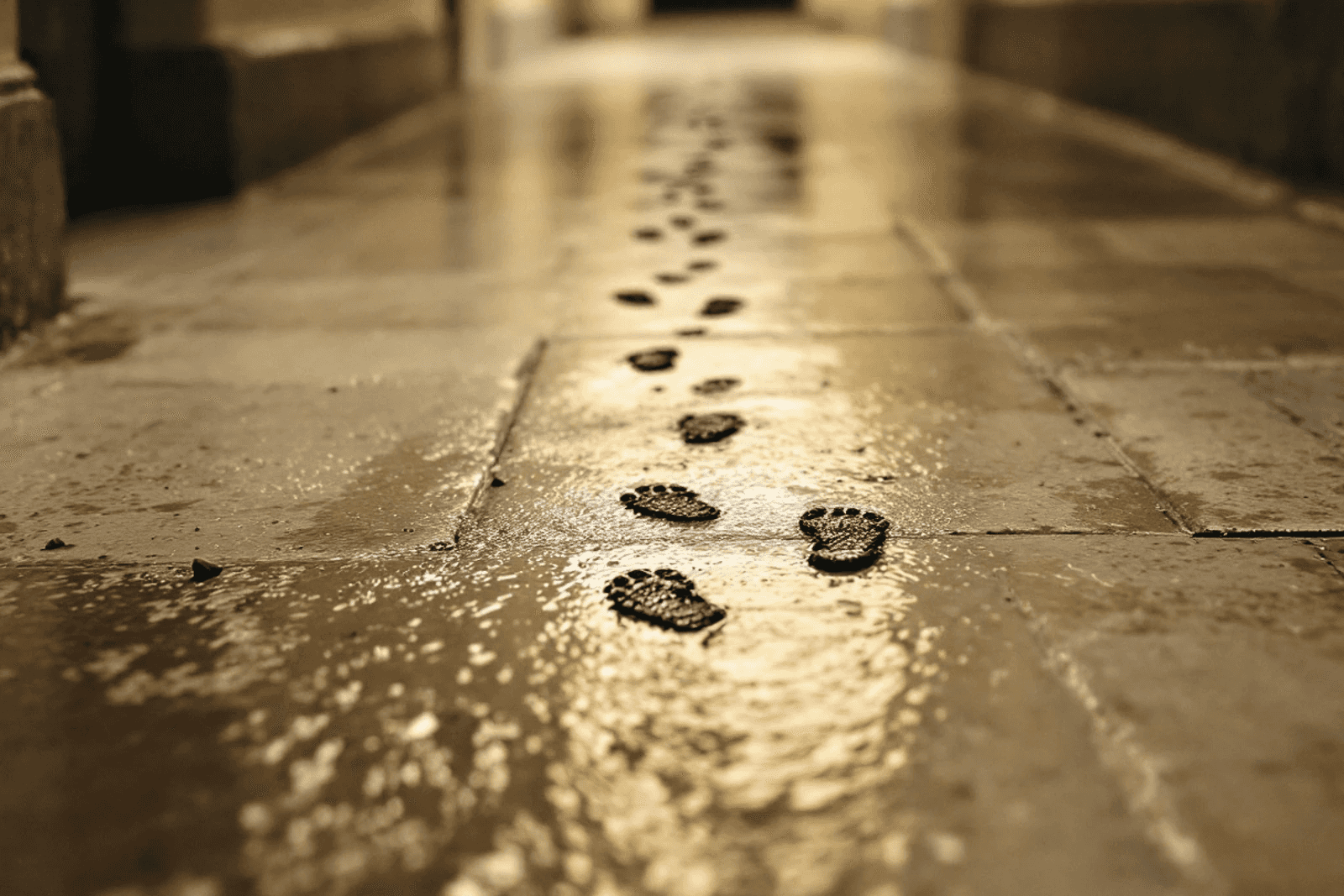
The house stood in Athens, and nobody would live in it. Around AD 100 the Roman writer Pliny the Younger passed its story on in a letter: at night the rooms filled with the sound of iron, and then an old man in chains appeared. A philosopher named Athenodorus rented the house anyway.
A ghost, in the only sense the record can support, is an account: someone saw, heard or felt a presence that nobody could explain, and took it for the dead. Some accounts are a figure in a doorway, some are knocks and moving objects, some are only the certainty of being watched. Whether anything stands behind them is still open. What can be laid out is what people report, what has been counted, and which ordinary causes have been measured.
The house in Athens
The story goes that Athenodorus was writing when the figure came, and that it beckoned. He followed it into the courtyard, to the spot where it vanished, and marked the place. When the ground was dug up there, bones were found wrapped in chains. They were given a proper burial, and the house, Pliny says, was quiet after that.
Pliny does not claim to have seen any of it. He tells it as something he had heard, which is how most ghost stories have arrived ever since: secondhand, with a place and a detail you could check if you had been there. A figure, an address, a wrong that wants putting right. Nearly two thousand years later the cases in our hauntings section still have that shape.
What people describe
Read enough accounts and they sort themselves into a few kinds. Investigators have names for them, and the names are worth knowing, as long as you know what they are.
An apparition is a figure seen: a person, sometimes clear enough to describe the clothes, sometimes only a shape at the edge of vision. A poltergeist, from the German for a noisy spirit, is the opposite case. Nobody is seen, but things happen: knocks, thrown objects, furniture that moves. The best-known modern example, the Enfield poltergeist, centered on a single mother and her four children in a council house in north London.
Residual and intelligent are terms from ghost hunting practice. A residual haunting is said to repeat like a recording, the same footsteps on the same stairs, indifferent to whoever is listening. An intelligent haunting is said to respond: to answer a question, to knock back.
These words are a folk taxonomy, not scientific categories. They come from the practice of looking for ghosts, not from any science that has confirmed their objects, and they carry assumptions inside them: that a place can hold a recording, that something is there to answer. They are useful for sorting reports. They are not evidence that the kinds exist, and no instrument sorts a reading into one of them, as our guide to what ghost hunting equipment actually measures sets out.
Counting the witnesses
In 1882 a group in London founded the Society for Psychical Research to examine reports like these methodically. Its most ambitious early project was the Census of Hallucinations, published in 1894. The society asked about 17,000 people whether they had ever seen or heard a figure that was not there. Roughly one in ten said yes.
The census proved nothing about the dead. What it showed was that the experience was ordinary: not a rare event among a credulous few, but something a tenth of the people asked could remember. Later counts are not strictly comparable, because the questions differ, but they have not gone to zero. A 2009 survey by the Pew Research Center found that 18 percent of Americans said they had seen a ghost or been in the presence of one.
Those numbers are measurements of people, not of ghosts. They say how many carry the experience. They say nothing about its cause.
The rappings in Hydesville
The same century produced the case that shows how hard the question is to close. In 1848, in Hydesville, New York, rappings began in the house where the Fox sisters lived, and the raps seemed to answer questions put to them. Crowds came to listen. Out of that house grew modern Spiritualism, a movement of séances and mediums that spread across the United States and beyond it.
In 1888 Margaret Fox confessed that the raps had been made by cracking her toe joints. Later she recanted the confession. So the record holds both: a sister saying she did it, and the same sister taking it back. Neither statement closes the case, and the movement it started had not waited for either.
What has been studied
None of the explanations below accounts for every report. Each accounts for some, and each has been examined closely enough to be called by its precise name.
Sleep paralysis
On waking or falling asleep, the body can stay paralyzed while the mind comes up. People in this state commonly report a felt presence in the room, often at the bedside or pressing on the chest, sometimes seen and sometimes only known. It is well documented in sleep research, and it has the shape of many night-time visitation stories: a bedroom, a person who cannot move, something in the room with them.
Infrasound
In 1998 the engineer Vic Tandy published a paper about a laboratory where people felt watched and saw a grey figure at the edge of their vision. He measured a standing wave of sound at about 19 Hz in the room, below the range of normal hearing, and proposed that the wave, not the room’s history, was producing the experience. The paper did not explain every haunted room. It showed that one of them could be measured.
Carbon monoxide
A faulty boiler, furnace or flue can fill a house with a gas that has no smell and no color. Carbon monoxide poisoning produces headaches, confusion and, at higher exposures, hallucinations. The symptoms stay with the house rather than the person and ease when the family goes out. That is also a description of a haunting. It is the one explanation on this list that can kill, which is why a detector belongs in a house long before a ghost hunter does.
Suggestion and expectation
Expectation shapes perception. A person told that a room is haunted walks into it listening, and notices sounds and shapes they would otherwise pass over, then remembers them in the light of the story. This does not mean the person invented anything. It means the story arrived first, and the room was read through it. The same process works on anyone who has just watched a ghost film, which is worth remembering when reading the true stories behind the films.
Bereavement hallucinations
The last is the gentlest. Widowed people often report seeing, hearing or sensing the person they lost: a voice in the kitchen, a figure in the usual chair. Researchers who study grief treat these experiences as a normal part of it, not as a sign of illness. For the people who have them, the explanation does not always change what the experience meant.
What the record does not settle
Set the explanations side by side and they cover a great deal.
| Explanation | What it can account for |
|---|---|
| Sleep paralysis | The presence at the bedside |
| Infrasound | The figure at the edge of vision |
| Carbon monoxide | The house where everyone feels unwell |
| Suggestion and expectation | The room read through a story told first |
| Bereavement hallucinations | The voice of a husband in the months after the funeral |
What they cannot do is cover every case, because most cases were never measured. The moment passed, the room was not tested, and what remains is an account.
The same is true of the frames people send in as proof, which is why our footage pieces look at the camera before they look at the figure. A photograph can be examined. A memory of a room at three in the morning cannot, not in the same way.
So the question stands where Pliny left it. People have reported the dead for as long as there are letters to read, in numbers that have not gone away, and the record holds both the reports and some of their causes. It does not hold the answer. Nobody took an air sample in that courtyard in Athens, and nobody can say now what Athenodorus followed to the place where the chains were buried.