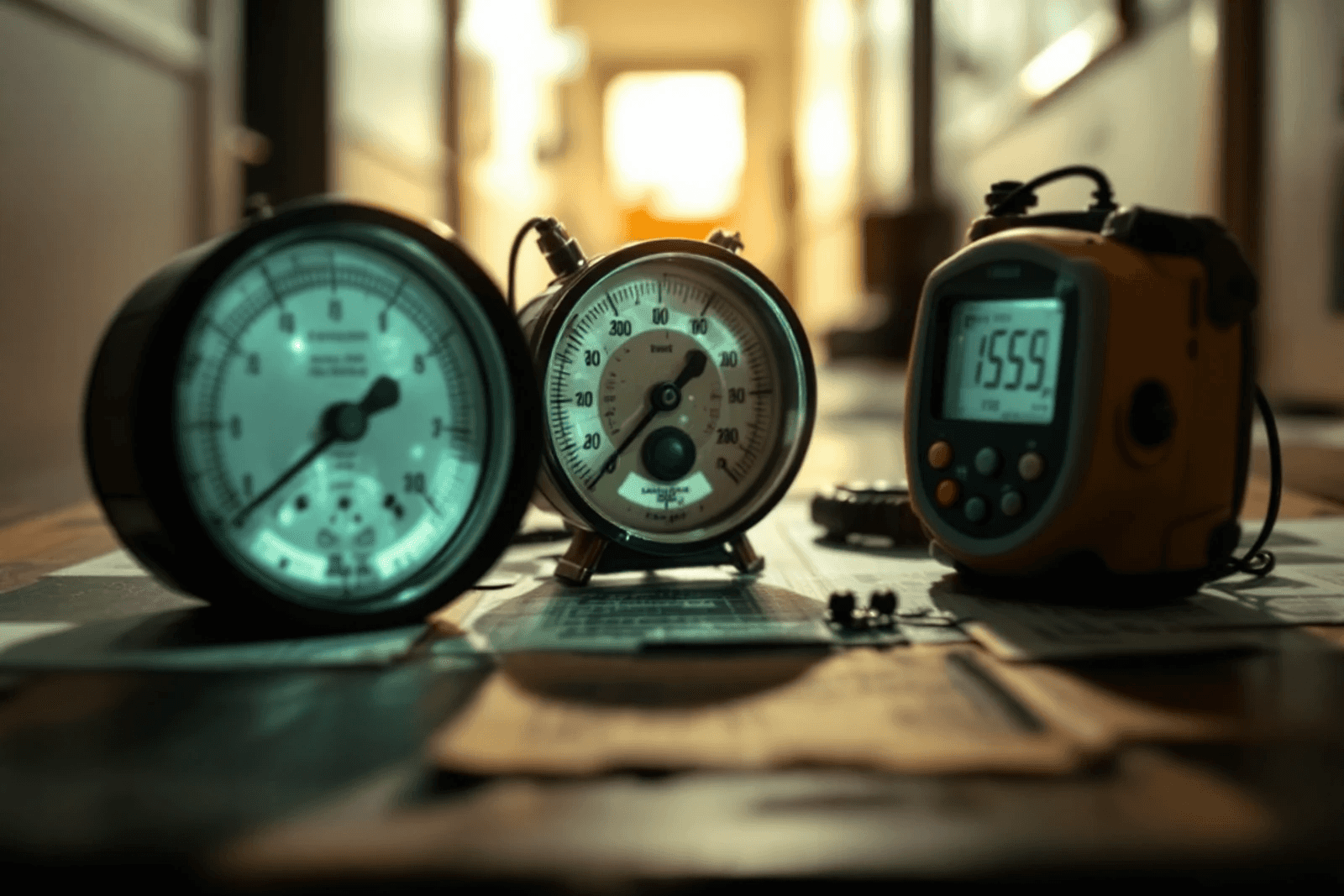
The five lights on the K-II climb from green to red at the bedroom doorway, hold, and fall back. Something happened there. What the meter can tell you is exactly one thing: the electromagnetic field at that spot changed.
Every device in a ghost hunter’s bag works the same way. It measures one ordinary physical quantity, a field, a temperature, a sound, a break in a beam, and the ghost is an interpretation laid on top of the reading. Below, device by device: what it physically measures, what ordinary things set it off, and what a careful investigator does about that. This is not a buying guide. There are no products to recommend here, only readings to understand.
| Device | What it actually measures |
|---|---|
| EMF meter (K-II) | Electromagnetic field strength |
| Spirit box (P-SB7) | Nothing; it sweeps radio stations |
| Digital voice recorder | Every sound in range |
| Thermal camera (FLIR) | Surface temperature, not air |
| Full-spectrum camera | Visible, near-infrared and ultraviolet light |
| REM pod | Changes in the nearby electromagnetic field |
| Laser grid | That something crossed the beam |
| Thermometer | Temperature, with a lag |
EMF meters
An EMF meter measures the strength of an electromagnetic field, usually in milligauss. The K-II, the one with the row of colored lights, is the model most people picture.
What sets it off is almost everything in a lived-in house. Household wiring behind the plaster, phones, appliances, unshielded cables, a fuse box on the other side of a wall. The meter’s own movement counts too: sweep it through a field and the reading jumps, then falls when your hand stops.
What a careful investigator does: walk the empty house first, before anyone asks a question, and map where the meter reads high. Note where the wiring runs. Keep phones out of the room or switched off. Hold the meter still, or set it down, and only then treat a change as a change. A spike at the doorway means something in a room that has already been mapped, or it means nothing.
Spirit boxes
A spirit box such as the P-SB7 is a radio that does not stop on a station. It sweeps through AM or FM frequencies at a set rate, so what comes out is a stream of broadcast fragments, each a fraction of a second long, laid over static.
Nothing has to be set off. The fragments are real speech from real stations, cut into syllables, and the listener’s brain does the rest. Hearing words in noise is auditory pareidolia, and it is strongest when you are listening for an answer to the question you just asked.
What a careful investigator does: record the session and listen back later, not in the moment. Have several people write down what they hear independently, without hearing each other’s versions first. If three listeners write three different words, that is the result. Knowing which stations broadcast in the area helps too.
Digital voice recorders and EVP
EVP, electronic voice phenomena, means voices on a recording that nobody heard when it was made. The device is an ordinary digital voice recorder.
What it picks up is everything in range. The investigator’s own breathing, clothing moving against itself, footsteps on the floor above, distant traffic, a pipe settling. The sensitivity setting matters: turned up, the recorder amplifies faint sounds and its own self-noise, the hiss every recorder produces with nothing to record. That hiss is fertile ground for the same pareidolia a spirit box feeds.
What a careful investigator does: say out loud every noise they make, a cough, a creak, a shift in a chair, so the tape carries its own labels. Record a control in the same room with nobody speaking, at the same settings. Note the setting in the log. The tapes Maurice Grosse made at Enfield, told in our account of the Enfield poltergeist, show how long a recording can outlast the argument about what is on it.
Thermal cameras
A thermal camera such as a FLIR measures surface temperature by infrared and paints it as color. It sees surfaces, not air. A cold draft is invisible to it until it cools something solid.
What sets it off: reflective surfaces. Glass, polished tile, a glossy door and some metals reflect infrared, so the warm shape on the window is often the person holding the camera. Residual heat is the other one. A hand on a wall or a body in a chair leaves a warm print that fades over minutes, a shape where nobody is standing.
What a careful investigator does: move and watch whether the figure moves with you. Keep track of who touched what and when. Scan the room when you enter it, so a warm patch has a before.
Full-spectrum cameras
A full-spectrum camera is a camera whose sensor has been left open to near-infrared and ultraviolet as well as visible light. The pictures come out in unusual colors, and anything that reflects infrared strongly glows in a way the eye never sees.
What sets it off: fabrics, foliage, some paints and skin all reflect IR differently, and an IR light source makes the effect stronger. A bright patch in a full-spectrum frame is a surface doing what it does in infrared.
What a careful investigator does: shoot the same frame with an ordinary camera from the same spot. If the anomaly exists only in the full-spectrum image, the difference is the spectrum. We look at frames like these closely in our footage section.
REM pods
A REM pod has a telescoping antenna and reacts to changes in the local electromagnetic field around it, much as a theremin does. When something disturbs the field, it lights and sounds.
What sets it off: any conductive body nearby. A person leaning in, a hand passing, a pet, and sometimes the field shifts of electrical equipment in the next room.
What a careful investigator does: place it away from where people walk, and film it continuously, so every trigger can be matched to who was nearby at that second.
Laser grids
A laser grid projects a pattern of dots across a room. Anything that crosses the beam breaks the pattern, and on video the break looks like a shape passing through.
What sets it off: insects, dust, a curtain moving in a draft, and anyone in the room. The grid shows that something crossed the light. It does not show what.
What a careful investigator does: film the grid with light enough to see what is in front of it, and check the frame for insects and dust before anything else.
Motion sensors, thermometers and cat balls
Motion sensors trigger on movement in their field of view, and a pet, a moving curtain or a shift in heat or light can be enough. Thermometers read drafts, the cooling of evaporating moisture, and their own lag: a sensor carried from a warm room to a cold one takes time to catch up, and the slow drop can look like a cold spot arriving. Touch-activated toys, the light-up “cat balls,” react to being touched or jarred, and a footstep on a loose floorboard can jar them.
What a careful investigator does: let each sensor settle before reading it, and write down where people were standing when it fired.
A protocol that holds up
No device on this list is more reliable than the method around it. A rigorous investigation looks the same whatever is in the bag:
- Baseline readings of the empty house before anyone starts asking questions.
- Control recordings in the same rooms, at the same settings, with nothing expected.
- Two independent devices measuring the same thing, so a single faulty unit cannot make the case.
- A written log with times, so every reading can be matched to what people were doing.
- The same test repeated, because one reading is an event and a repeated one is a result.
Why people report ghosts in the first place, and which ordinary causes have been measured, is set out in what is a ghost. More cases are in our hauntings section, and if you have a recording made this way, you can send it to us.
What no device measures
None of these instruments has a setting for the dead. Each measures a field, a temperature, a sound or a beam, and each will report the ordinary world faithfully to anyone who asks it.
That is what makes a careful reading worth having. Map the house, log the times, repeat the test, and most readings will find their cause. The ones that remain are not proof of anything. They are readings nobody has explained yet, logged with a time and a place, and much rarer than a spike on a meter.