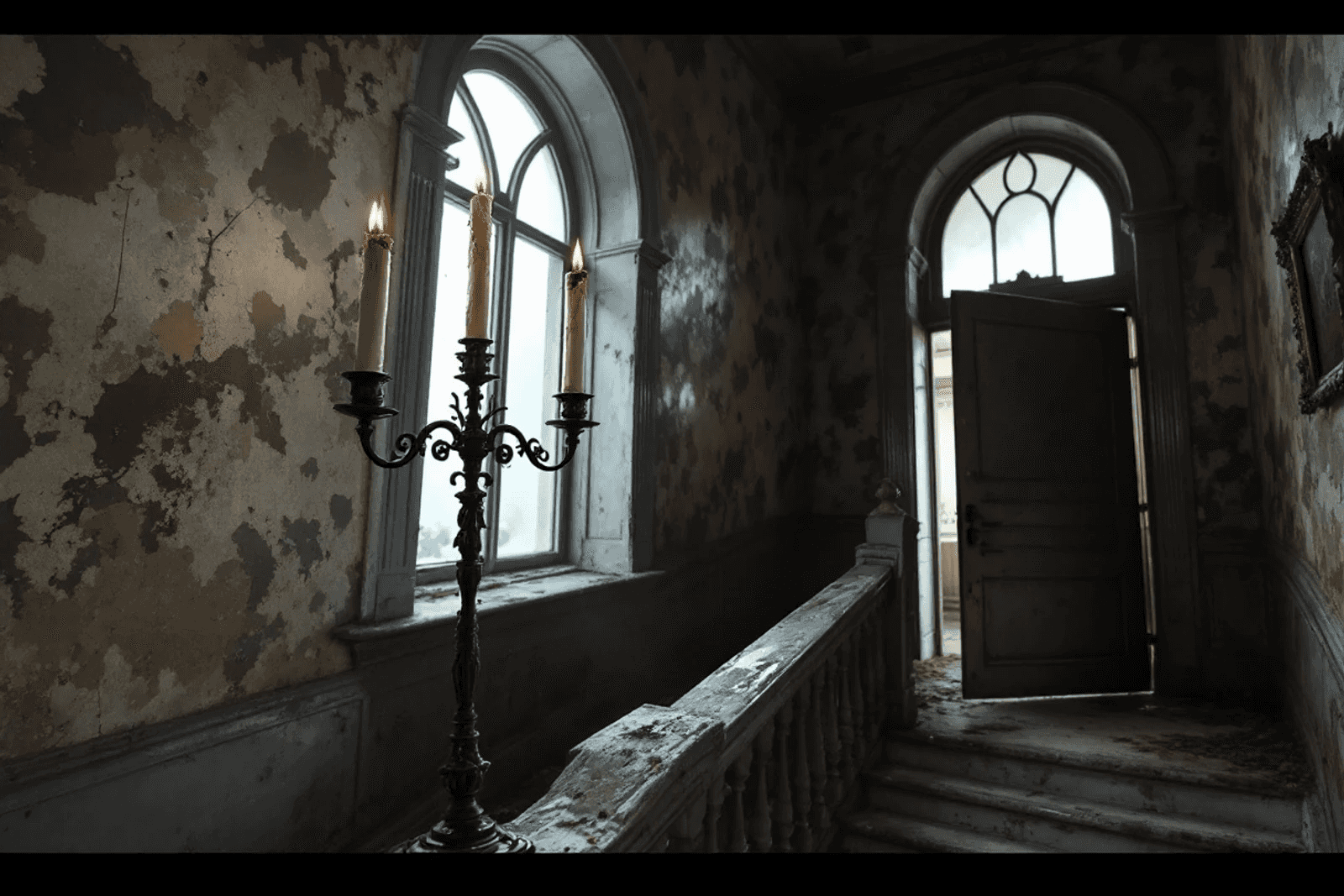
A gothic ghost film is a haunted-house film with a secret at its center: an old, isolated house, a family or a history that will not stay buried, and a ghost that turns out to be the secret itself. The seven to watch, in order: The Innocents (1961), The Haunting (1963), The Others (2001), The Devil’s Backbone (2001), The Orphanage (2007), The Woman in Black (2012) and Crimson Peak (2015). None has a real case behind it. Only Crimson Peak is on Netflix, and The Devil’s Backbone streams free.
What “gothic” means here
The word is older than cinema by a century and a half. Wikipedia’s entry on Gothic fiction, where “Gothic horror” redirects, calls it “a literary aesthetic of fear and haunting,” built on “an environment of fear, the threat of supernatural events” and the past intruding on the present. Its settings were castles, monasteries, convents and crypts. The first book to carry the label was Horace Walpole’s The Castle of Otranto (1764), whose second edition added the subtitle “A Gothic Story.”
Film kept the shape and traded the castle for a country house. Three kinds of ghost movie files several of these films under the haunted house, and that is where they live. What makes them gothic is the extra layer: a governess, a widow, a bride or an orphan, alone in a building that knows something about the family before she does. The haunted house asks whether a place remembers. The gothic film asks what it remembers, and whose fault it was. How the ghost got from the stage to the screen in the first place is traced in how ghosts got on screen.
The seven films, in order
1. The Innocents (1961)
- Director: Jack Clayton
- Source: Henry James’s 1898 novella The Turn of the Screw, by way of William Archibald’s 1950 stage play. Screenplay by Archibald and Truman Capote, extra dialogue by John Mortimer, photographed by Freddie Francis.
- The fact to keep: Pauline Kael called it “the best ghost movie I have ever seen.” Archibald and Capote won the 1962 Edgar Award for best motion picture screenplay.
- Real case behind it: none. It is fiction.
- Where to stream (US): fuboTV only. No free option and no digital rental; otherwise it means buying the DVD or Blu-ray. The hardest film on this list to see.
2. The Haunting (1963)
- Director: Robert Wise
- Source: Shirley Jackson’s novel The Haunting of Hill House (1959). Exteriors were filmed at Ettington Park in Warwickshire, interiors at MGM-British Studios, Borehamwood.
- The fact to keep: Martin Scorsese placed it first on his list of the 11 scariest horror films of all time.
- Real case behind it: none.
- Where to stream (US): Shudder, AMC+, Philo. Rent or buy on Amazon, Apple and Fandango. JustWatch shows “leaving soon” notices on this title without saying which service, so check. Make sure you pick the 1963 film, not the 1999 remake.
3. The Others (2001)
- Director: Alejandro Amenábar, who also wrote the score
- Source: an original screenplay by Amenábar. It is often compared to The Turn of the Screw, and William Skidelsky of The Observer suggested the novella as an inspiration; the makers have not been quoted confirming it.
- The fact to keep: made for $17 million, it grossed $210 million worldwide and became the highest-grossing Spanish film to that date. It won eight Goyas, including Best Film, the first English-language film without Spanish dialogue to take that prize.
- Real case behind it: none.
- Where to stream (US): Shudder, AMC+, Philo. Rent on Amazon, Apple and Fandango. If you have seen it, what the ending means.
4. The Devil’s Backbone (2001)
- Director: Guillermo del Toro
- Source: an original film, set in Spain in 1939 at a remote orphanage run by Republican loyalists, with a cache of gold hidden on the grounds. Wikipedia’s entry calls it a “gothic horror film.” In Spanish.
- The fact to keep: del Toro first planned it as a story set in Mexico, named after the mountain range there called the Devil’s Backbone.
- Real case behind it: none for the ghost. The war around it is real: the last year of the Spanish Civil War.
- Where to stream (US): no subscription service. Free with ads on Tubi and Fawesome. Rent on Amazon, Apple, Fandango and Spectrum.
5. The Orphanage (2007)
- Director: J. A. Bayona, in his feature debut
- Source: an original script by Sergio G. Sánchez, who wrote the first draft in 1996. Del Toro co-produced and helped win it a larger budget and a longer shoot. In Spanish.
- The fact to keep: it premiered at Cannes on May 20, 2007, and won seven Goyas, among them Best New Director and Best Original Screenplay. The house is Partarríu Manor in Llanes, Asturias.
- Real case behind it: none.
- Where to stream (US): no subscription and no free option. Rent on Amazon, Apple, Fandango and Spectrum.
6. The Woman in Black (2012)
- Director: James Watkins
- Source: Susan Hill’s 1983 novel, adapted by Jane Goldman. A 1989 adaptation came first.
- The fact to keep: it had the biggest US opening in Hammer’s history and grossed about $130 million worldwide. In Britain it drew 134 complaints to the BBFC over its 12A rating, the most for any film of 2012. Eel Marsh House is Cotterstock Hall near Oundle; the causeway is on Osea Island, Essex.
- Real case behind it: none. It is fiction.
- Where to stream (US): fuboTV and Paramount+. Free on Kanopy with a library card. Rent on Amazon, Apple and Fandango.
7. Crimson Peak (2015)
- Director: Guillermo del Toro
- Source: an original script by del Toro and Matthew Robbins, written after Pan’s Labyrinth, with an uncredited rewrite by Lucinda Coxon. Wikipedia lists The Haunting, The Innocents and The Shining among its inspirations.
- The fact to keep: del Toro called it “a really, really, almost classical Gothic romance ghost story.” It took $74.7 million worldwide against a $55 million budget.
- Real case behind it: none.
- Where to stream (US): Netflix, since October 1, 2026. Rent on Amazon, Apple and Fandango.
How to pick one tonight
- You want the source of everything else: The Innocents, then The Haunting. The two black-and-white films, and two of the films Crimson Peak drew on.
- You want ambiguity, not answers: The Innocents. Ghosts or a governess’s mind, and the film never settles it.
- You want a twist that rewards a second viewing: The Others.
- You want a ghost that is also history: The Devil’s Backbone, then The Orphanage, which del Toro co-produced.
- You want the most direct scares on the list: The Woman in Black, the film British viewers complained about.
- You want color, costume and romance with your ghosts: Crimson Peak.
- You want it free tonight: The Devil’s Backbone on Tubi.
For newer ghost films and everything else streaming this month, see ghost movies to watch this Halloween. For films that do rest on a real case, and how much of each holds up, see ghost movies based on true stories. Everything for October 31 is gathered on the Halloween page.
The houses are real
None of these ghosts happened, but some of the houses are real. Ettington Park in Warwickshire, Cotterstock Hall near Oundle and Partarríu Manor in Llanes are buildings you can find on a map. The films lent each of them a ghost. Whether any of them had a story of its own before the crews arrived, nothing we read says.