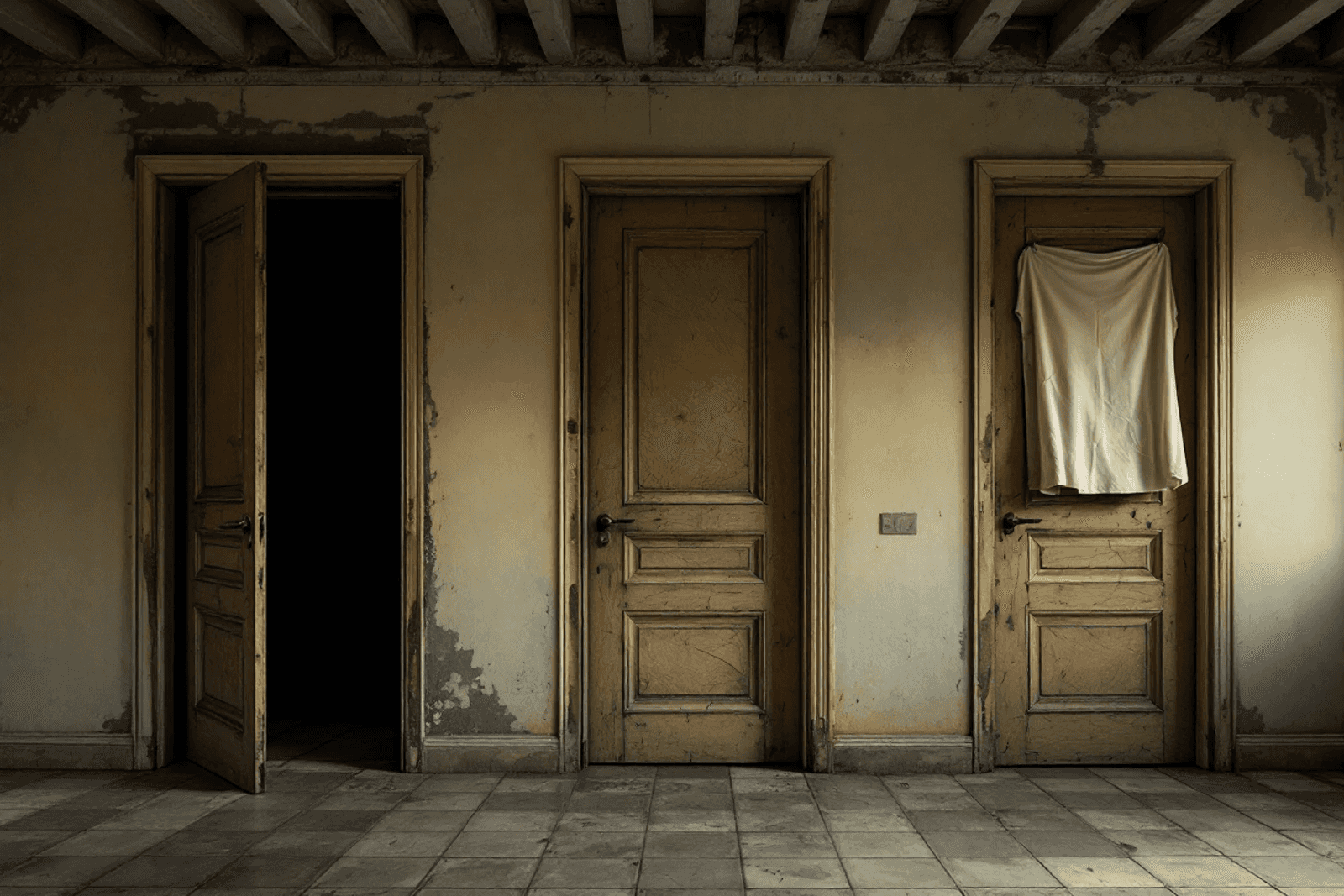
Most ghost movies are one of three films. In the haunted-house film, the ghost belongs to a place and the living have moved into it. In the possession or poltergeist film, the ghost wants a person, or a whole family, and finds a way in. In the found-footage film, the camera is inside the story, and the real question is whether the tape can be trusted. Each kind asks you to believe something different, points its camera somewhere different, and gives its ghost a different want. The films named below are examples of each, and none of their endings is given away.
The haunted house: the ghost was here first
What it asks you to believe. That a place can keep what happened in it. The house is older than the family, and the family is the newcomer.
The camera. Wide, slow and patient. It holds on corridors and doorways, lets the architecture fill the frame, and trusts you to search the background yourself. The fear sits in the depth of the shot, in the room behind the room.
What the ghost wants. Usually to stay, or to be known. The house has a story it has not finished telling, and the living are in the way of it, or are the only ones who can hear it.
- The Haunting (1963, Robert Wise). A researcher brings a small group to Hill House to study it. The film barely shows a ghost, and the house does nearly all the work.
- The Changeling (1980, Peter Medak). A grieving composer rents a large old house, and the house begins to ask him for something.
- The Others (2001, Alejandro Amenábar). A mother keeps her two children in a house of drawn curtains, because they cannot bear the light.
- The Conjuring (2013, James Wan). A family in a farmhouse, and Ed and Lorraine Warren called in to investigate. How much of it happened is covered in ghost movies based on true stories.
- Crimson Peak (2015, Guillermo del Toro). A gothic house sinking into red clay. Its heroine, a writer, says of her own manuscript that it is not a ghost story but a story with a ghost in it, which is a fair description of the whole kind.
The haunted-house film is the oldest of the three, and its roots run back past the cinema to the stage. That history is traced in how ghosts got on screen. The real houses, and what the record says about them, are in hauntings.
Possession and the poltergeist: the ghost wants in
What it asks you to believe. That the house is not really the problem. The family is. Something has attached itself to a person, usually a child, and it will not be left behind at the old address.
The camera. Close. It stays on bodies, faces and beds, on a child’s room at night. The effects are physical: a body doing what bodies do not do, furniture moving when nobody touches it. “Poltergeist” is German for a noisy spirit, and the poltergeist film watches objects the way the haunted-house film watches doorways.
What the ghost wants. A way in. A body to use, a voice to borrow, a child to take. Of the three kinds, this is the one where the ghost’s want is clearest and most personal.
- The Exorcist (1973, William Friedkin). A girl in Georgetown, a mother, and two priests. The presence is a demon rather than a ghost, but the film wrote the grammar every possession movie since has used.
- Poltergeist (1982, Tobe Hooper). A suburban family, a small daughter, and a television left on after the broadcast day ends.
- Insidious (2010, James Wan). A boy falls into a sleep nobody can explain or wake him from.
- Hereditary (2018, Ari Aster). It begins with a family funeral. Saying where it goes from there would spoil it.
Found footage: the camera is the witness
What it asks you to believe. That this was recorded, not staged. The film presents itself as a tape someone found, a documentary someone made, or a camera someone forgot to turn off. You are asked to treat the picture as evidence.
The camera. Inside the story. Someone holds it, or it sits on a tripod, and it can only see what it happens to be pointed at. Handheld shake, night-vision green, a time code in the corner. The fear lives at the edge of the frame and in the part of the room the light does not reach. Look at the doorway, not the people.
What the ghost wants. Often it does not say. The found-footage ghost rarely explains itself, because the camera only records and cannot ask. What the film wants is clearer: for you to lean toward the screen and look for what the characters missed.
- The Blair Witch Project (1999, Daniel Myrick and Eduardo Sánchez). Three student filmmakers go into the Maryland woods to make a documentary about a local legend. It made found footage a genre.
- Paranormal Activity (2007, Oren Peli). A couple puts a camera on a tripod in their bedroom to record what happens while they sleep.
- Lake Mungo (2008, Joel Anderson). An Australian film made as a documentary about a family after their teenage daughter drowns. It is quiet, and it is built out of photographs and home video.
- Grave Encounters (2011, the Vicious Brothers). The crew of a ghost-hunting television show spends a night locked inside an abandoned psychiatric hospital.
- Hell House LLC (2015, Stephen Cognetti). A documentary about the team behind a haunted-house attraction, and about its opening night.
Real clips that borrow this grammar, and claim to show a real ghost, are looked at frame by frame in the footage section.
The three kinds side by side
| Kind | What you are asked to believe | Where the camera is | What the ghost wants |
|---|---|---|---|
| Haunted house | A place keeps what happened in it | Wide and slow, holding on doorways | To stay, or to be known |
| Possession and poltergeist | The family, not the house, is the target | Close on bodies, faces and beds | A way in |
| Found footage | The tape is evidence, not a performance | Inside the story, handheld or fixed | It rarely says |
Plenty of films mix them. The Conjuring borrows from the first two kinds at once, and Poltergeist keeps returning to the house even as it follows the family. But most ghost movies lean hard toward one kind, and knowing which tells you where to look.
The exception: when the ghost is the lead
There is a fourth shape, rarer, where the camera takes the ghost’s side.
- Beetlejuice (1988, Tim Burton). A recently dead couple try, without much talent for it, to frighten the new owners out of their house.
- Ghost (1990, Jerry Zucker). A murdered man stays near the woman he loves and tries to reach her through a reluctant medium.
- A Ghost Story (2017, David Lowery). A figure under a white sheet with two eyeholes stands in the house where it used to live, and watches.
These turn the haunted-house film inside out. The ghost is still the one who will not leave, but now it is the character we follow, and the living are the strangers moving through its rooms. More on how each kind was built is in the films section.
The three main kinds each put the ghost somewhere the camera cannot quite reach: deep in the frame, under the skin, past the edge of the light. The exceptions put the camera under the sheet. What they find there is someone standing in a room, waiting, and not able to say for what.