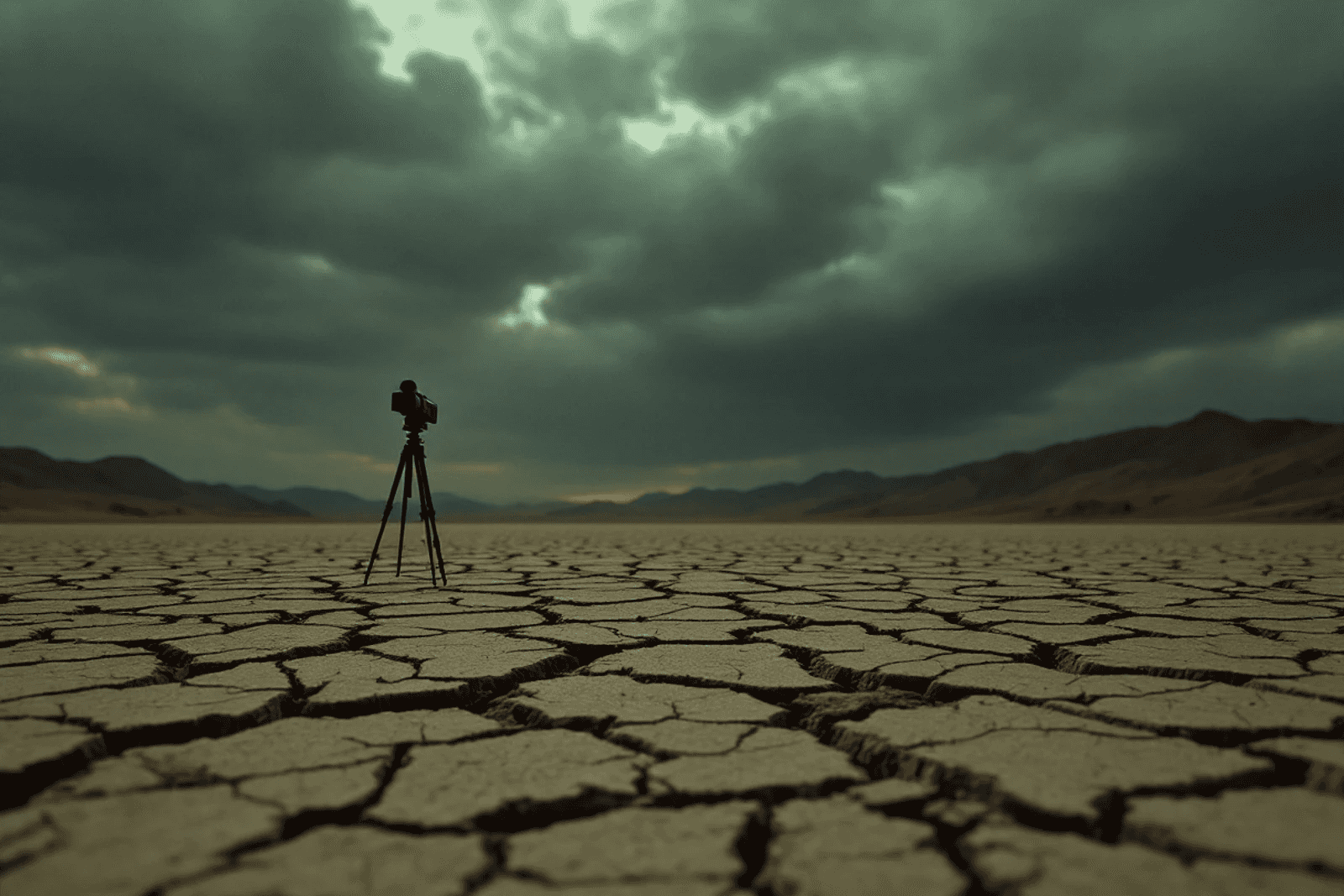
No. Lake Mungo (2008) is a fiction film, a scripted mockumentary written and directed by Joel Anderson, and nothing in it happened. Lake Mungo itself is real: a dry lake in Mungo National Park, in the far west of New South Wales.
The family, the drowned girl, the neighbors, the psychic and every ghost on the tape are invented. What makes people ask is the form: talking heads, family snapshots, home video, and Anderson himself, uncredited, as the voice asking the questions.
What is real and what is invented
The lake sits about 760 km west of Sydney, inside the World Heritage-listed Willandra Lakes Region, and Wikipedia describes it as dry for roughly 20,000 years. It is where Mungo Man was found, which Wikipedia calls “the oldest human remains found in Australia.”
Ararat, where the story happens, is a real town in Victoria. The Brag and the Australian Cinema database both say the film was shot there. Whether the crew also visited the real lake is not settled; the sources disagree.
Everything else is fiction. Alice Palmer, her parents June and Russell, her brother Mathew, the neighbors Brett and Marissa Toohey and the psychic Ray Kemeney are characters. No real case stands behind them, and we found no record of the film being sold to audiences as true, which is the difference between this film and Ghostwatch, where a broadcast audience did take it as real.
How Anderson made it
The script was an outline with no written dialogue, Wikipedia says. The actors improvised, and Anderson cast little-known faces to keep the documentary feel. “I think we were thinking it’d be nice if we could make a film that was kind of a curiosity,” he said. Wikipedia adds that he has given no interviews since 2009, and returned in 2023 as executive producer and script editor on Late Night with the Devil.
The clues, in the order the film gives them
The plot follows Wikipedia’s summary, checked against Rosie Fletcher’s 2020 piece for Den of Geek and Richard Scheib’s review on Moria.
- The dam. Alice Palmer, 16, disappears while swimming with her family at a dam in Ararat. Her body is found days later. June will not view it; Russell identifies her.
- The house. About ten days after the funeral, Mathew has bruises nobody can explain and the family hears noises. Russell reports an apparition. June dreams of Alice, drenched.
- The photographs. Mathew takes up photography and seems to catch Alice in the backyard, then in what Moria calls “a photo near the lake that has what appears to be Alice’s figure in the background.”
- The exhumation. Mathew sets up cameras. An exhumation and DNA test confirm the body is Alice’s. June goes to Ray Kemeney, and his séance settles nothing.
- The confession. Months later Mathew admits he faked the ghost photos and videos, to push his parents into the exhumation so that June could see her daughter again.
- The bedroom. A recording made while the family was away seems to show Alice’s apparition and Brett Toohey searching her room. Den of Geek stresses that this footage, unlike the earlier sightings, was not faked.
- The tape. June finds a hidden videotape of Alice with Brett and Marissa Toohey, whose child Alice used to babysit. Russell concludes Brett was looking for it. The Tooheys sell up and vanish. Police say any charge would probably bring a suspended sentence, because the encounter would be treated as consensual.
- Ray’s account. Alice had visited Ray before she died. She told him about recurring dreams of drowning and a fear that her mother could not see or help her. Her journal agrees.
- Lake Mungo. Jason Whittle hands over phone footage from a school trip to the lake. It shows Alice burying something under a tree. The Palmers dig up her phone, watch and bracelet. On the phone, Alice walks the shore at night and meets a bloated, disfigured figure of herself, the body as it was found at the dam.
- The departure. The Palmers believe it is over and leave. In Alice’s bedroom June hears the recording of Ray’s session, and Alice says “she’s gone.” A photograph from the move shows a faint figure in a window. Footage in the end credits shows Alice in the background, and a post-credits scene shows her ghost at Lake Mungo in a thunderstorm.
Lake Mungo ending explained: our reading
This section is interpretation, ours and the critics’ we name, not anything the film states. The film runs two hauntings at once. The first is Mathew’s, made out of grief, and the film lets it be exposed halfway through. The second keeps going after the exposure: the bedroom footage, the phone, the final images. Having taught you to distrust the pictures, it shows you pictures nobody faked.
The Toohey tape explains why Brett was in her room. It does not explain the drowning dreams or the figure on the shore, and the film says nothing more about the Tooheys than the tape and the police verdict.
Alice told Ray she was afraid her mother could not see her. By the end June has seen the tape, the phone and the drowned girl on the shoreline, and Alice says “she’s gone”: the daughter finally seen, the haunting over. The credits undercut it. Den of Geek reads those images as Alice staying in the house, unseen by the family. Closure for the living, and a ghost none of them notices.
Did Alice foresee her own death? Is the figure on the shore a premonition, a double, or her ghost meeting her future? Was the drowning an accident? No source we read settles any of it. Anderson called the film an exploration of grief and rejected the idea that it is simply a supernatural film.
Why it looks real
Every piece is a convention from real documentaries: talking-head interviews, family photographs, home video, a psychic, an interviewer who stays off screen, a documentary score. Den of Geek says it “plays like a documentary.” The Brag’s writer says their partner took it for a genuine ABC documentary.
This next point is our own reading; no critic we found makes it. Mathew’s fake pictures, made so that a grieving mother could see her daughter again, repeat the oldest story in spirit photography, where families paid to see their dead in a print. The figure in the background of a lake photograph is the type of image our page on orbs, mist and faces takes apart. The film builds that image, has its maker confess, then lets the same figure turn up with no maker at all.
Its descendants know the trick. Stephen Cognetti has named it as an influence on Hell House LLC, and our page on Hunting Matthew Nichols sets it beside Blair Witch and Ghostwatch as a precedent for that film’s fake documentary. Among the three kinds of ghost movie it is the one built from photographs and home video. Mike Flanagan called it “exceptional, terrifying, and ultimately heartbreaking.”
Where to watch Lake Mungo in the US
As of October 20, 2026, JustWatch lists these US options, free first. Re-check before you press play.
| How | Where |
|---|---|
| Free | Kanopy (through a participating library), Fawesome |
| Free with ads | Tubi, Plex, Xumo Play |
| Subscription | Shudder, AMC+ (also as a channel on Amazon and Apple TV), Howdy Amazon Channel |
| Subscription, leaving soon | Lionsgate+ Amazon Channel and Philo, both marked “leaving in 10 days” |
| Rent or buy | Amazon, Apple TV, Fandango at Home |
Creepy Catalog dates its arrival on Shudder to October 1. It is on our list of ghost movies to watch this Halloween, and the rest of the season is on the Halloween page.
Last checked: October 20, 2026, against JustWatch US. Streaming rights move.
What does not fit
There is a photograph from the day the Palmers leave the house. It belongs to the part of the story where the haunting is over, where Alice has said “she’s gone” and her mother has finally seen her. In one window of that photograph there is a faint figure, and nobody in the family sees it.