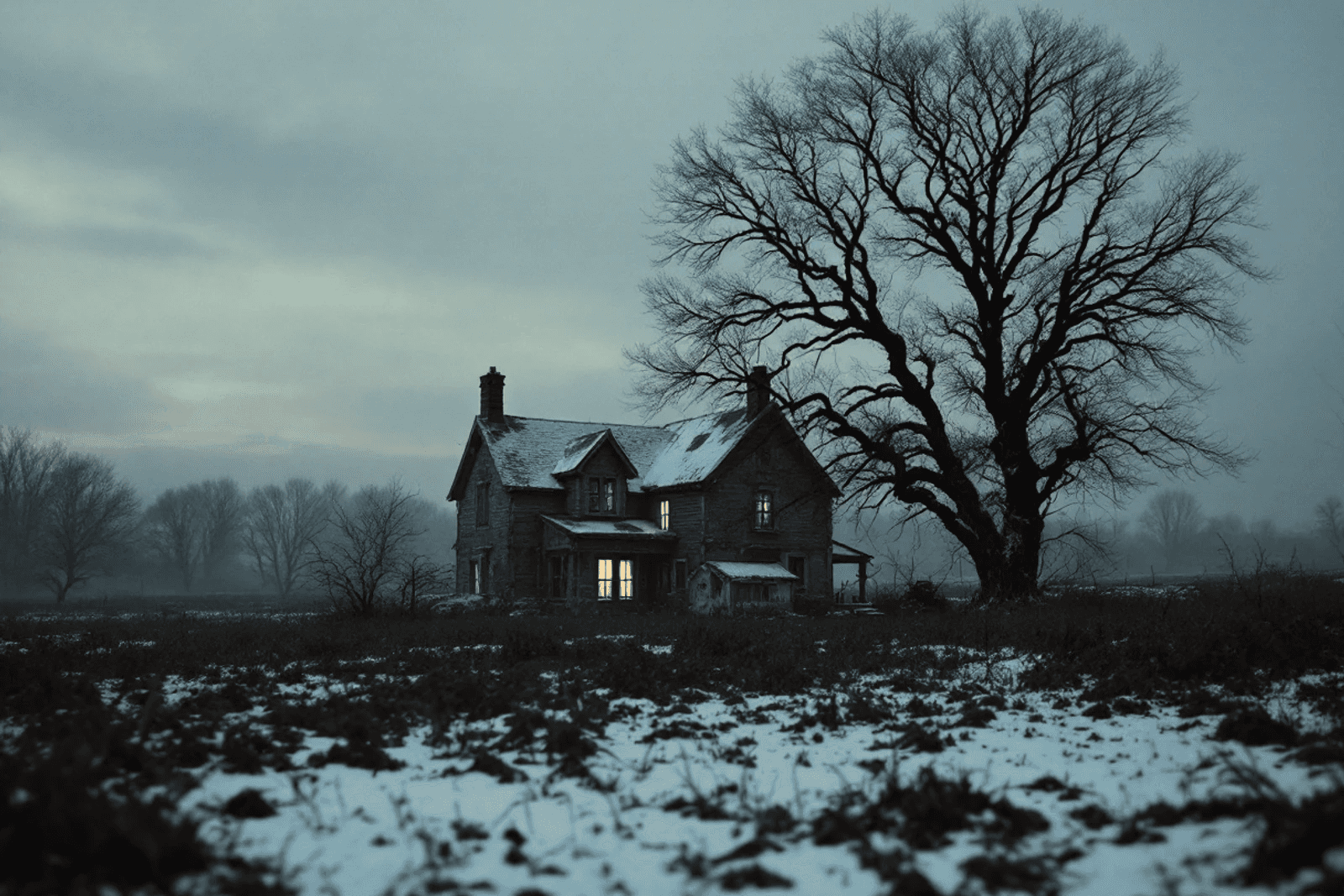
In January 1971, Roger and Carolyn Perron moved their five daughters into a farmhouse in Harrisville, Rhode Island. Andrea, Nancy, Christine, Cindy and April were the girls. The house was known as the Old Arnold Estate and had stood since the 1730s. The family stayed until 1980, and the story they later told about those nine years is the true story behind The Conjuring (2013).
The short answer is this. The film takes the Perrons, the house and a visit from Ed and Lorraine Warren, and builds a horror film around them. The family’s own version of that visit ends differently: with a séance that went badly for Carolyn, and Roger asking the Warrens to leave.
The house and the family
The Old Arnold Estate is a farmhouse of the old New England kind, with more than two centuries of other people’s lives in it by the time the Perrons arrived. A house that old has had births, deaths and illnesses in its rooms simply by lasting. That fact is ordinary, and it is also the soil a haunting story grows in.
Seven people moved in that winter: two parents and five girls. What the family said happened over the next nine years comes almost entirely from them. There is no police file and no court case. There is the family’s memory, and later there is a book.
What the family said
Andrea Perron, the eldest, wrote the account down decades later. Her memoir, House of Darkness House of Light, runs to three volumes, the first published in 2011. It is the fullest record of what the Perrons say they lived through, and it is a family’s record: written by someone who was a child in the house, looking back as an adult.
The title carries its own argument. The Perrons have not described a single evil presence in a single room. The book’s name holds both halves, the dark and the light, and that is already a different shape from the film’s. Anyone who wants the family’s own words has three volumes of them, and they are the only first-hand account of those nine years that exists.
Keep the two kinds of sentence apart here. “The family said” is the strongest claim this story can make. It is a real claim from real people who lived in the house, and it is not the same thing as a record that anyone else could check.
What the Warrens actually did
Ed and Lorraine Warren visited the farmhouse in the early 1970s. By the Perrons’ account, the Warrens held a séance in the house. It went badly for Carolyn, and Roger asked them to leave.
That is the whole of it, in the family’s telling: a visit, a séance, a mother in distress, a father who wanted it over. Nothing in that version resembles a rescue.
The film builds its second half on the Warrens instead. Vera Farmiga and Patrick Wilson play them as the heroes of the case, arriving with equipment and a team, staying through the worst of it, and ending the haunting in a climax that belongs to the film. If you watched The Conjuring and came away thinking the Warrens saved the Perrons, that is the film’s story, not the family’s.
Bathsheba Sherman, the woman in the legend
Bathsheba Sherman was a real woman. She lived from 1812 to 1885, not far from the farmhouse. The legend calls her a witch. No record supports it.
The film goes much further than the legend and makes her the source of everything. That choice is worth pausing on, because it hangs a supernatural crime on a woman who can no longer answer for herself, and whose documented life contains nothing of the kind. When the story goes one way and the record goes another, this site follows the record. Here the record is a name, two dates and a neighborhood.
What the film changed
The Conjuring was directed by James Wan and became one of the highest-grossing horror films of its decade. It is a well-made film, and it is a film. It keeps the year, 1971, the farmhouse setting and the five daughters. Lili Taylor and Ron Livingston play Carolyn and Roger.
What it changes is structure.
| What the family said | What the film shows |
|---|---|
| Nine years in the house, 1971 to 1980 | A compressed season of escalating events |
| The Warrens visit, a séance goes badly for Carolyn, and Roger asks them to leave | The Warrens arrive with equipment and a team, stay through the worst of it, and end the haunting |
| Bathsheba Sherman, 1812 to 1885, a neighbor the legend calls a witch; no record supports it | A villain with a motive and the source of everything |
Those are the choices a horror film makes to reach an ending, and the Perrons’ story, as they tell it, does not have one of those.
The film also opens on another Warren case entirely, the Annabelle doll, which went on to anchor films of its own. That is a reminder of how the film was built. It is framed around the Warrens’ case files, and the Perrons are one case among several in that universe. The sequel, The Conjuring 2 (2016), moved on to the Enfield poltergeist in north London.
For how other films handled the gap between an address and a screenplay, see the Amityville case, where the distance between the family’s account and the record is wider still.
Where the house is now
The Perrons left in 1980. In 1987 Norma Sutcliffe and Gerald Helfrich bought the house. They said they experienced nothing unusual there. After the film came out they complained of a different problem: trespassers, strangers on the property looking for the house from the film.
In 2019 Cory and Jennifer Heinzen bought the farmhouse and opened it to paranormal investigations. In 2022 it was sold to Jacqueline Nuñez, and tours and overnight stays continue. The house that a couple once had to defend from strangers now invites them in.
- January 1971 Roger and Carolyn Perron move their five daughters into the Old Arnold Estate.
- Early 1970s Ed and Lorraine Warren visit; by the family’s account, a séance goes badly and Roger asks them to leave.
- 1980 The Perrons leave the farmhouse.
- 1987 Norma Sutcliffe and Gerald Helfrich buy the house.
- 2011 Andrea Perron publishes the first volume of House of Darkness House of Light.
- 2013 The Conjuring, directed by James Wan.
- 2019 Cory and Jennifer Heinzen buy the farmhouse and open it to paranormal investigations.
- 2022 The house is sold to Jacqueline Nuñez; tours and overnight stays continue.
More houses with a before and after like this one are gathered under hauntings, and the wider list of films built on real cases is in films.
What does not fit
Two sets of owners lived in the same rooms. The Perrons, by their account, lived through nine years they are still writing about. Sutcliffe and Helfrich, by theirs, lived through decades of nothing, and the only thing that came to their door was the film.
Both accounts come from people who slept in the house. Neither can be checked against the other. And the woman the legend blames has been dead since 1885, with nothing in her record to explain why her name ended up on the other side of the story.
If you have visited the farmhouse and have a record of what you saw, send it to us.