On January 14, 1976, George and Kathy Lutz left 112 Ocean Avenue in Amityville, Long Island, with Kathy’s three children. They had moved in on December 18, 1975. They stayed twenty-eight days.
That is the true story behind The Amityville Horror (1979), and it has two layers that should never be confused. The first is a crime, fully on the record: six people killed in the house thirteen months before the Lutzes arrived. The second is the haunting, which rests on the Lutzes’ account, reached the world through a bestselling book, and has been disputed since 1979.
November 13, 1974
The record begins here. On November 13, 1974, Ronald DeFeo Jr., aged 23, shot his parents, Ronald Sr. and Louise, and his siblings Dawn, Allison, Marc and John Matthew, in their beds at 112 Ocean Avenue.
In 1975 he was convicted of six counts of second-degree murder. He died in prison in 2021.
Those six names are the part of this story that is not in dispute, and the part the later versions tend to hurry past. The house became famous for a haunting. It was first known for a family that died in it.
The twenty-eight days
George and Kathy Lutz bought the house for about $80,000. They moved in on December 18, 1975, with Kathy’s three children. On January 14, 1976, they left.
What happened in between is the Lutzes’ account. The story goes that the house turned on them almost at once. In the version that became famous, there were flies gathering in a room in the middle of winter, a voice that told a priest to get out, a presence the youngest child described as a friend, and eyes at a window at night. The family said they left with their belongings still in the house.
None of this reached a police file. It is not the kind of thing that does. It is the family’s story, told by the family, and every sentence of it belongs under “the Lutzes said.”
The book and the films
The account became a book. Jay Anson’s The Amityville Horror was published in 1977, built on the Lutzes’ telling, and it became a bestseller. The book’s cover promised a true story, and that promise is the thing everything since has been arguing about.
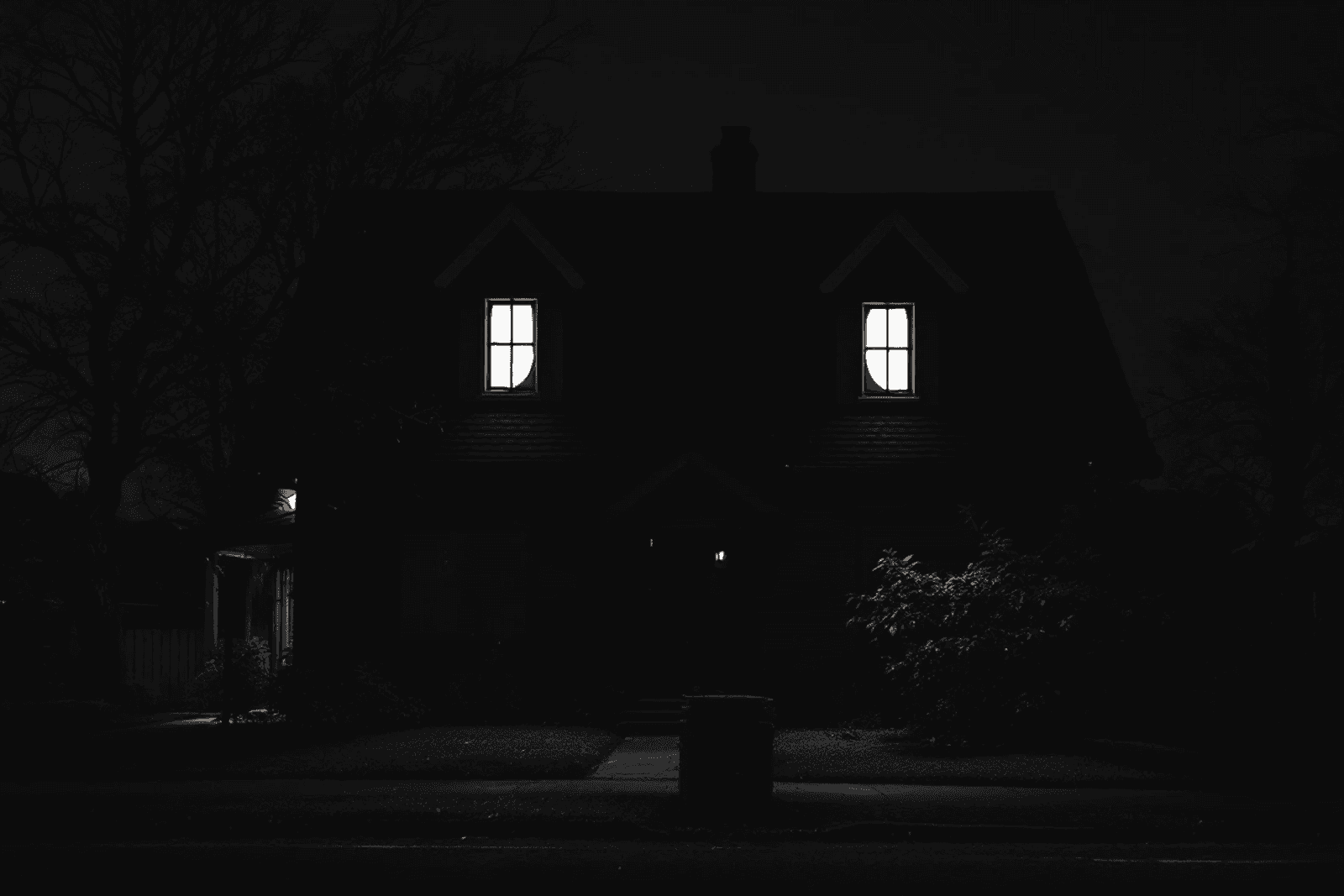
The film followed in 1979. Stuart Rosenberg directed it, with James Brolin and Margot Kidder as the Lutzes. The house on screen, with its two quarter-moon windows looking out from the top floor like a pair of eyes, became the image most people picture when they hear the name. A remake came in 2005, directed by Andrew Douglas, with Ryan Reynolds in the role of George Lutz.
The Warrens appear here too. The Conjuring 2 (2016) opens with Ed and Lorraine Warren at Amityville, which ties this address to the film universe built on the Perron family’s farmhouse, another case where the family’s account and the film’s version part ways.
“Many bottles of wine”
In 1979, William Weber, who had been DeFeo’s defense attorney, said that he and the Lutzes had “created this horror story over many bottles of wine.”
That sentence is the most quoted piece of evidence against the haunting, and it is worth reading carefully for what it is. It is a claim from a named person, made in 1979, three years after the Lutzes left, by the lawyer who had represented the man convicted of the murders. It does not prove the Lutzes invented everything, any more than their account proves a haunting. It puts a second story next to the first.
The Lutzes stood by their account. So the record holds both: a family that said the house drove them out, and a lawyer who said the story was made at a table.
The Cromartys and the new address
In 1977 Jim and Barbara Cromarty bought the house. They reported nothing unusual. What they did report was the story itself: the people who came to look, the attention a book and a film had brought to a private home. They sued over that intrusion.
The house itself was altered. The address became 108 Ocean Avenue. The quarter-moon windows, the detail every poster and cover had used, were replaced. A house that had been made into a face had its eyes taken out.
It has changed hands several times since and is a private home. It is not a place to visit, and the people who live there are not part of the story.
- November 13, 1974 Ronald DeFeo Jr. shoots six members of his family at 112 Ocean Avenue.
- 1975 DeFeo is convicted of six counts of second-degree murder.
- December 18, 1975 George and Kathy Lutz move in with Kathy’s three children.
- January 14, 1976 The Lutzes leave.
- 1977 Jay Anson’s The Amityville Horror is published; Jim and Barbara Cromarty buy the house.
- 1979 Stuart Rosenberg’s film is released; William Weber says the story was made “over many bottles of wine.”
- 2005 The remake, directed by Andrew Douglas.
- 2021 DeFeo dies in prison.
More houses whose later owners saw nothing are collected under hauntings, and the other films built on real cases are in films.
One address, two stories
Put the two layers side by side.
| The crime | The haunting | |
|---|---|---|
| When | November 13, 1974 | December 18, 1975, to January 14, 1976 |
| People | Ronald DeFeo Jr. and the six members of his family he shot | George and Kathy Lutz and Kathy’s three children |
| Source | A conviction on six counts of second-degree murder | The Lutzes’ account, a book and two films |
| Against it | Nothing; it is not in dispute | William Weber’s 1979 “many bottles of wine” |
| End | DeFeo’s death in prison, 2021 | Disputed since 1979 |
They share one address, and they share nothing else that can be checked.
The film era that followed learned a different trick: instead of telling you what a family saw, it put the camera in the room and let you look for yourself. That is the subject of the fixed camera in Paranormal Activity.
What does not fit
The Lutzes were in the house for twenty-eight days. The Cromartys, by their own account, found nothing in the house worse than the strangers outside it. The owners since have kept it what it is now, a private home.
And the six people who died there, whose deaths are the only part of this story the record fully holds, are the part that almost nobody came to Ocean Avenue to see. The windows have been changed. The number has been changed. The date, November 13, 1974, has not.
If something here is wrong or you can source a detail we have left out, write to us.