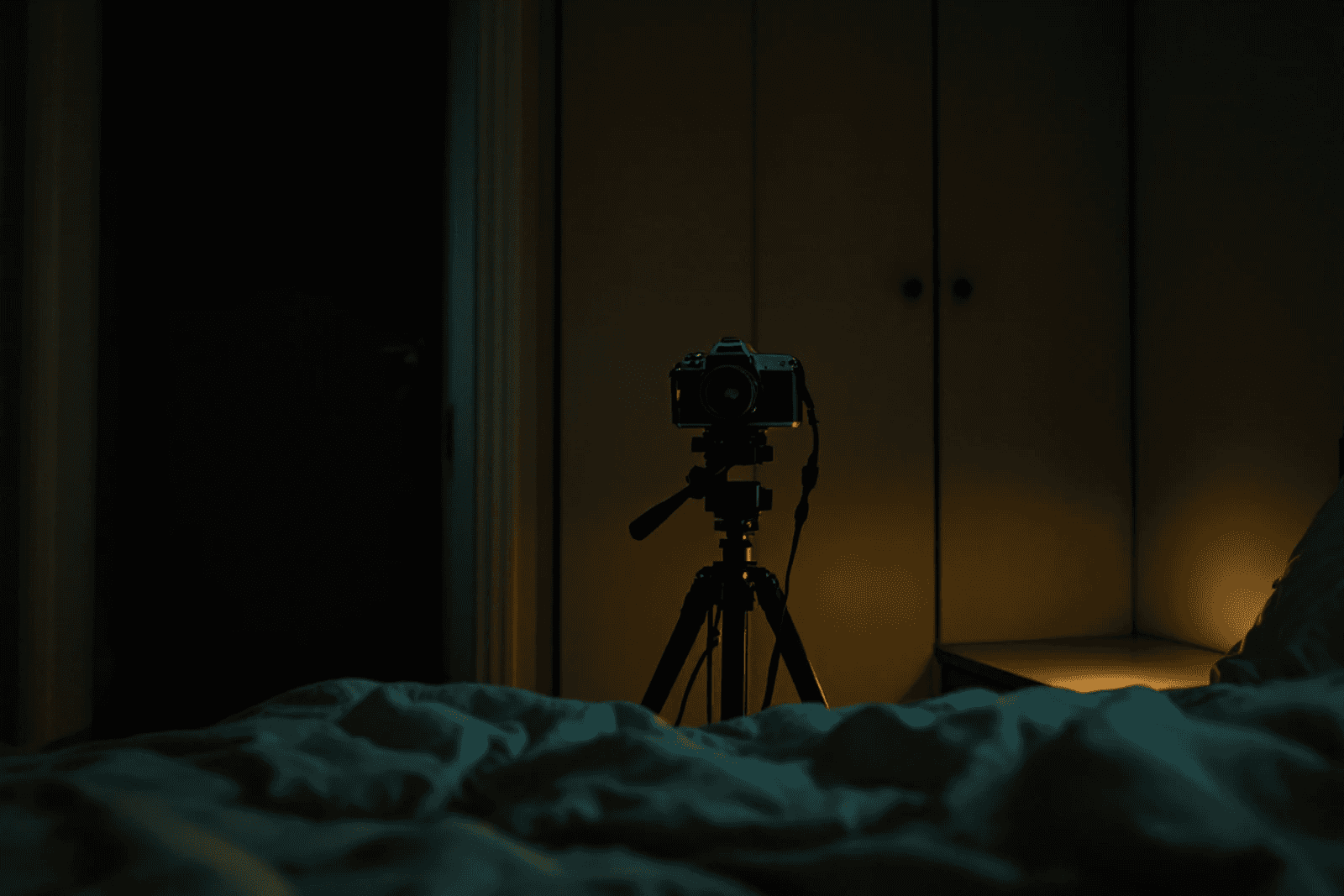
The camera sits on a tripod at the foot of the bed. A timestamp runs in the corner of the frame. Two people are asleep, the picture has the washed-out look of night vision, and for a long stretch nothing in the room moves.
That shot is why Paranormal Activity (2007) works. A locked-off camera gives you nothing to follow, so you search the frame instead. You watch the doorway, the sheets, the dark edge of the picture, waiting for one thing to be different from a second ago. The film turns the audience into the person at the monitor, and it lets the audience do most of the frightening work.
A house in San Diego, seven days, about $15,000
Oren Peli was an Israeli-born software programmer with no film experience. He wrote and directed Paranormal Activity himself and shot it in his own house in San Diego, over about seven days in 2006, on a budget of about $15,000.
The leads, Katie Featherston and Micah Sloat, were cast through improvised auditions, and they play characters with their own first names. That small decision does a great deal. There is no character name to separate the person on screen from the person in the room, and the film never gives you a reason to remember that it is a film.
The house is an ordinary suburban house. No history, no crime, no legend. The film has nothing to lean on but the camera.
From Screamfest to midnight screenings
The film premiered at Screamfest in October 2007. Paramount released it in 2009, and the release itself became part of the story. It opened first as midnight screenings in September, then went wide in October after an online “Demand It” campaign asked audiences to request it for their own towns.
It grossed well over $100 million worldwide. Set against a budget of about $15,000, that made it one of the most profitable films ever made relative to what it cost. It is hard to separate that number from the run of fixed-camera ghost stories that came after it.
What the frame shows
Here is the technique, as the tape presents it.
The camera is locked off on a tripod at the foot of the bed. It does not pan, it does not zoom, it does not look away. The bedroom door stands open on a dark hallway, and that doorway takes up a part of the frame your eye keeps going back to.
In the corner a timestamp runs. It tells you that time is passing and that nothing is being cut. When the counter jumps forward, you know hours went by in which nothing happened, and you start to wonder what the next stretch will hold. The timestamp is the film’s clock and its promise at once.
The image is night vision. Faces go flat and pale, dark corners go darker, and a shape in the hallway is exactly as readable as a coat on a hook. That ambiguity is the point.
Then the sound. Before something happens, a low rumble rises on the soundtrack, below speech, closer to a pressure than a noise. You feel it before you understand it, and by the second night you are listening for it.
Put those four things together and the viewer’s job changes. You are no longer watching a story. You are scanning a still frame for change, the way an investigator reviews the overnight tape. Look at the door, not the bed. Look at the edge of the light. When the door moves, you found it yourself, and that is why it lands.
This is the same discipline we use when we look at real footage that claims to show a ghost: fix your eye on the static parts of the frame, note the timestamp, and ask what changed and when. The method is set out in the footage section.
The camera that runs, and the camera that stays
The obvious comparison is The Blair Witch Project (1999), and it works the opposite way. The camera is handheld and almost never still. It runs through the woods, swings toward a sound, drops, finds a face, loses it. The terror in Blair Witch is what the camera cannot show you, because the person holding it is too frightened to point it steadily.
Paranormal Activity reverses that. The camera shows you everything, all the time, from one fixed position. Nothing is hidden by movement. What frightens you is that you can see the whole room and still cannot tell where the next thing will happen.
| The Blair Witch Project (1999) | Paranormal Activity (2007) | |
|---|---|---|
| The camera | Handheld, almost never still | Locked off on a tripod at the foot of the bed |
| What it shows | Whatever it swings toward, then loses | The whole room, all the time, from one position |
| Where the fear is | What the camera cannot show | Where in the visible room the next thing will happen |
Handheld chaos makes the viewer a passenger. The fixed camera makes the viewer a witness, and then an investigator. It is a quieter trick, and it does not need anyone to run.
The ending, and the one before it (spoilers)
Stop here if you have not seen the film.
The ending in the theatrical release was suggested by Steven Spielberg. It closes on the fixed camera in the bedroom and on something thrown at the lens, the frame finally broken by the thing the audience has been watching for.
An earlier ending exists, and it differs from the one Spielberg suggested. The fact that the ending could be changed at all says something about the method: the tripod, the timestamp, the night vision and the rumble stay the same, and the last few minutes are the only part that can be swapped out.
Where this sits in the section
The films built on real cases, like the Perron family’s farmhouse or the twenty-eight days at 112 Ocean Avenue, ask you to trust an account. Paranormal Activity asks for none. It is fiction, it says so in everything except its form, and its form borrows the look of evidence. The rest of the ghost films are in films.
What does not fit
The most effective shot in the film is one in which almost nothing happens. A bed, a doorway, a timestamp and the grey of night vision, held for so long that the audience starts to see things in it that may not be there.
That is pareidolia, the mind finding a shape in noise, and the film is built on it. Which leaves an odd question hanging over every night-vision clip that has been posted since. When you stare at a still frame waiting for a ghost, how much of what you find was put there by the film, and how much by you?