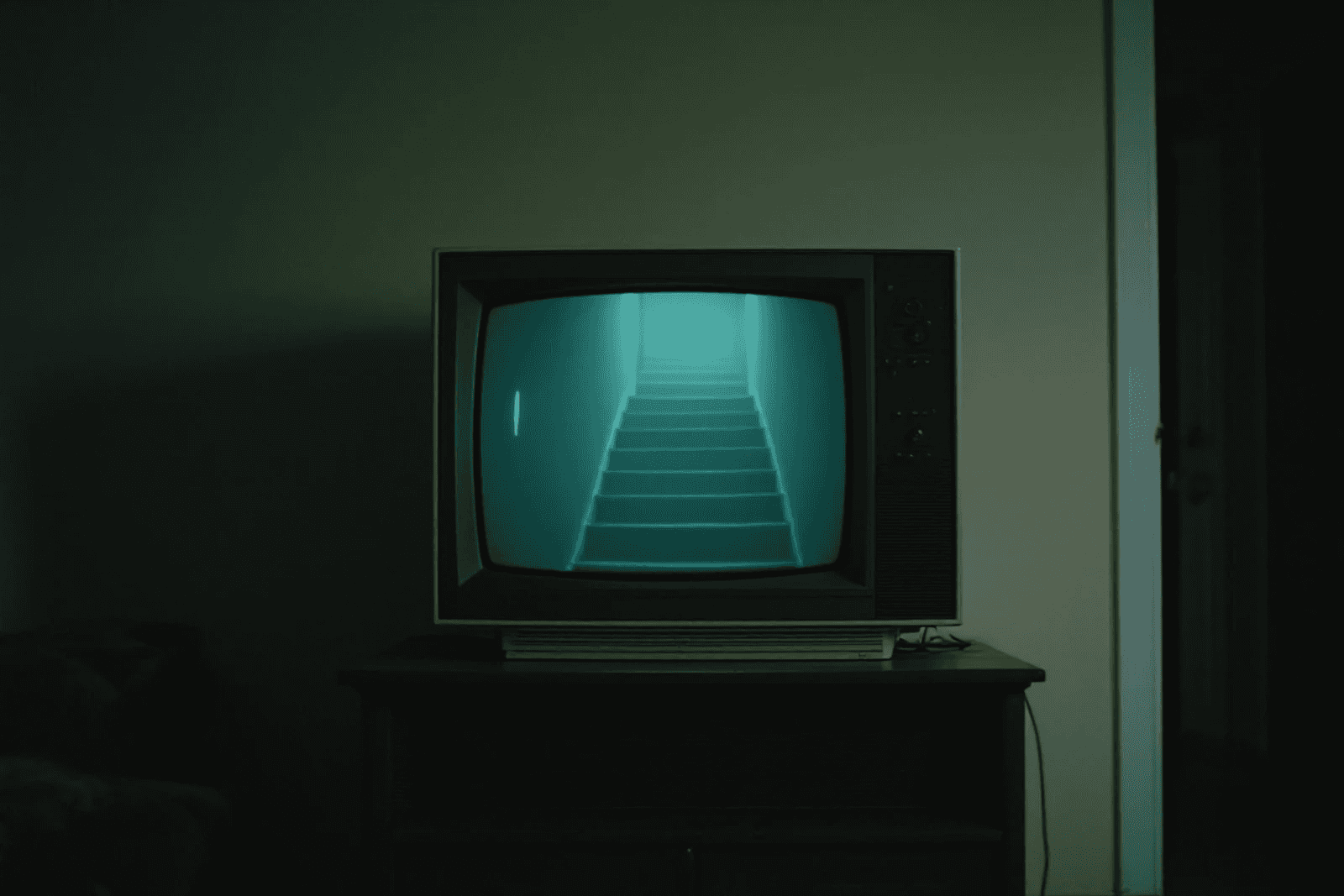
The house is on Foxhill Drive in Northolt, the camera is in the upstairs landing, and Michael Parkinson is in the studio asking a parapsychologist whether ghosts exist. None of it was real. Ghostwatch (1992) was a scripted drama, written by Stephen Volk and directed by Lesley Manning, broadcast by BBC1 in its Screen One drama slot on Saturday, October 31, 1992. Real BBC faces played themselves: Parkinson, Sarah Greene, Mike Smith and Craig Charles. A large share of the audience took it as live.
What the audience saw
The setup was a Halloween outside broadcast. Greene spent the night inside a council house with Pamela Early and her daughters, Suzanne and Kim. Charles worked the street outside, talking to neighbors about its history. Smith ran a phone-in, and Parkinson anchored from the studio beside Dr. Lin Pascoe, a parapsychologist played by Gillian Bevan.
The family called their poltergeist Pipes, because the knocking was first blamed on the plumbing. The story goes that he lived in the cupboard under the stairs, which the girls called the glory hole. Kate Mossman, writing in the New Statesman, describes him as a bald man in a long black dress buttoned to the neck. Manning voiced him herself after the hired voice artist could not give her what she wanted.
The look did most of the work. Screen One was usually shot on 16mm film; Ghostwatch was shot on videotape, which is what live television looked like. The on-screen number was the BBC’s standard call-in line. Callers who got through heard a message saying the programme was fiction, but only five operators were on, and many people heard an engaged tone instead.
In the last minutes, Pascoe realizes the broadcast itself has become a séance: millions of people watching, all wanting the same thing to happen at the same moment. Greene is dragged into the under-stairs room. The studio is overrun, and Parkinson appears possessed. “Here’s the patrician, sane voice of television,” Manning told Mossman, “but with horror going on at the same time.”
The night after
The BBC switchboard was flooded. Estimates run from about 20,000 calls to far higher; tens of thousands of calls, by most estimates. The tabloids attacked the BBC the next day. According to Ciarán O’Keeffe in The Psychologist, the continuity announcer did not acknowledge in any way that what had just aired was a drama.
Greene went on Children’s BBC the following Monday to reassure young viewers. Many of them knew her from children’s television, which later became part of the case against the programme.
In February 1994 the BMJ published a paper by Dawn Simons and Walter Silveira of Gulson Hospital, Coventry: Simons D, Silveira WR, BMJ 1994;308:389–90. As O’Keeffe and Mossman summarize it, it described two 10-year-old boys referred to a child psychiatry unit after watching Ghostwatch, with sleep disturbance, fear of the dark and separation anxiety, and attributed their trauma to the programme. Other doctors writing in the same journal a month later disputed whether television viewing could cause post-traumatic stress disorder at all.
Martin Denham, 18, died by suicide five days after the broadcast. His mother and stepfather, April and Percy Denham, blamed the programme. As O’Keeffe records, the coroner made no reference to it in announcing his verdict. The complaint that eventually reached the Broadcasting Standards Council came from the Denham family.
The council first rejected the Denhams’ complaint, with 34 others, as outside its remit. The High Court then granted the family permission for a judicial review, which required the council to hear it. Its ruling came in June 1995: “The BBC had a duty to do more than simply hint at the deception it was practising on the audience.” It also found the programme too distressing and too close to the 9pm watershed, and criticized the use of presenters from children’s programmes. The producers apologized.
Banned, or just never shown again
The usual version is that the BBC banned Ghostwatch for ten years. The Behind the Curtains FAQ, run by the people who know the programme best, answers that “strictly speaking, no”: there was no formal ban. The BBC simply never repeated it. It stayed off screens until the BFI released it on VHS and DVD in November 2002, and it has still never been shown again on British television. It has aired abroad, on Canada’s Scream channel in 2004 and Belgium’s Canvas in 2008.
Enfield, at one remove
Simon McCallum, writing for the BFI, calls Ghostwatch “inspired in part by the real-life Enfield Poltergeist case of the late 1970s,” and adds that Volk’s script does not set out to recreate the events at Enfield. The resemblance is in the household. Doris V. Sutherland, writing for Women Write About Comics in 2019, reads Suzanne and Pam Early as counterparts to Janet Hodgson and her mother Peggy, and Suzanne’s guttural voice as modeled on Janet’s.
One scene makes the debt plain. Suzanne is caught knocking with a toy telephone and pleads that she only wanted the investigators to stay. At Enfield, Janet admitted to playing some tricks. In both houses the faked knock did not end the story; it became part of it.
What it left behind
Manning was clear about the intent: “We never used the word ‘hoax.’ … We were unpicking the language of television.” Volk put it in terms of the oldest kind of ghost story: “Pointing a camera at someone and asking them questions is the equivalent of what you read in a ghost story.” Our history of how ghosts got on screen traces the earlier forms of that trick.
The programme kept a life off air. Rich Lawden’s documentary Ghostwatch: Behind the Curtains (2012), co-produced with Manning and made with the original cast and crew, premiered at BAFTA Piccadilly. Since 2010, fans have held the National Séance, playing their own copies at the original broadcast time every October 31 and posting under #NationalSeance. Rob Savage’s Host (2020), a séance over Zoom, uses the caller ID 31101992. The Blair Witch Project (1999) is a parallel rather than a descendant: co-director Eduardo Sánchez said the team did not know Ghostwatch until after their film came out. Hunting Matthew Nichols (2024), a Canadian film dressed as a true-crime documentary, plays the same trick and reaches Shudder on October 31, 2026. The fixed-camera ghost of Paranormal Activity works the same nerve, the frame you are told is a recording. Where it sits among the three kinds of ghost movie is a harder question, because it pretended not to be a movie at all.
Where to watch Ghostwatch now
As of October 2026, Ghostwatch streams in the US on Shudder and AMC+. In the UK no streaming subscription carries it; it is available as a digital purchase, and the 101 Films Blu-ray from 2022 is the main physical release. It belongs on any list of ghost movies to watch this Halloween, and the glitches that look like ghosts are worth knowing before you go looking for Pipes in the static.
Saturday, October 31, 2026 is the 34th anniversary, and it falls on a Saturday, as the first broadcast did. Somewhere a television will be switched on shortly after nine, tuned to a recording, and someone will watch a landing at the top of a staircase, waiting for something that was put there on purpose.