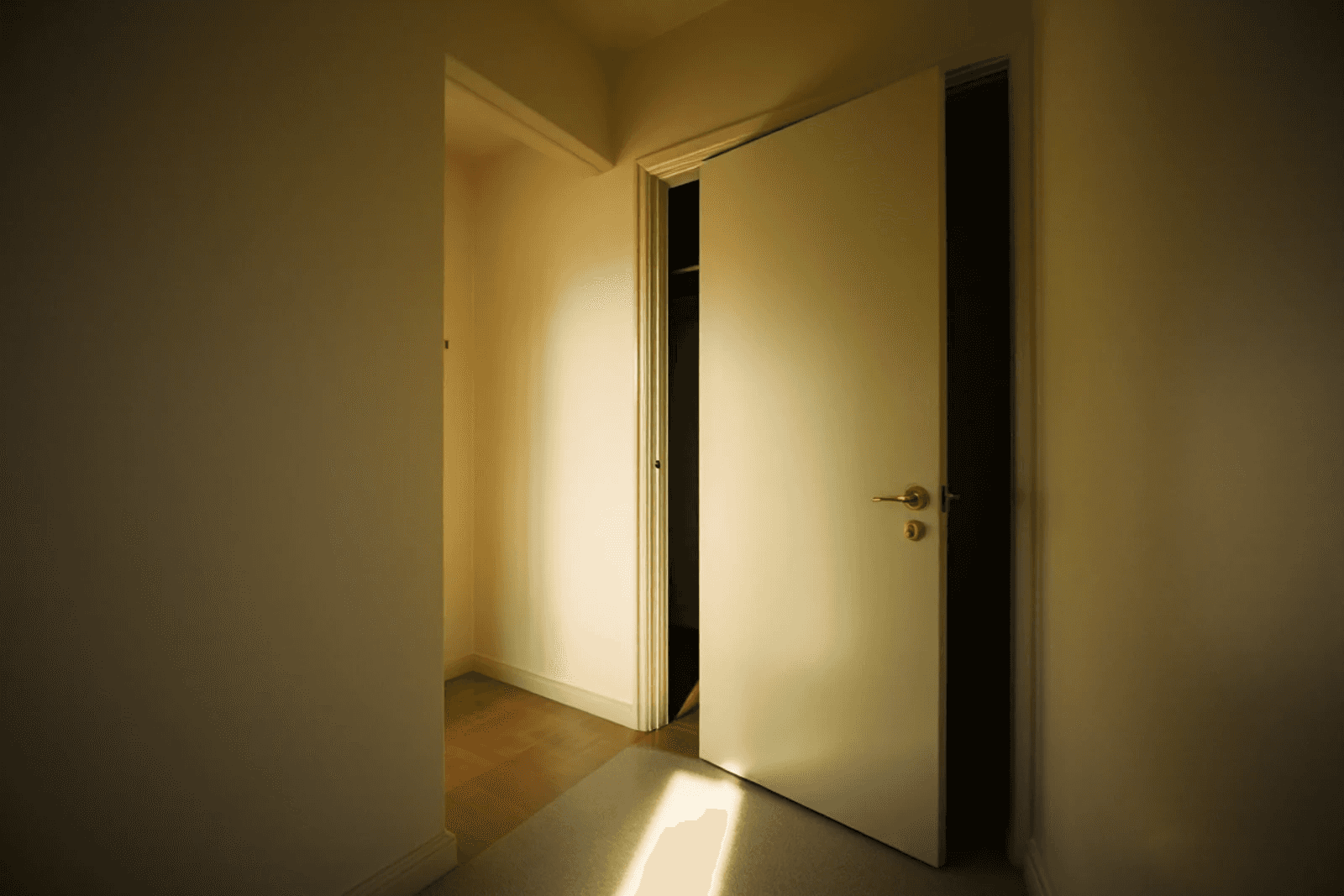
Josh Malerman’s brother and his wife put their child to bed one night, and the child said goodnight to “Other Mommy.” That remark is the only true thing behind Other Mommy (2026). The film, which opens in US theaters on October 9, 2026, is not based on a true story. It adapts Malerman’s 2024 novel Incidents Around the House, which is fiction, and we found no “based on a true story” claim in its trailers, its synopses or its makers’ interviews.
A goodnight in his brother’s house
Malerman, the author of Bird Box, told the story in a Q&A with The Nerd Daily:
“I’ve had the idea for some 13 years. My brother told me a story similar to the first chapter, about him and his wife putting their kid to bed for the night and the kid saying goodnight to ‘Other Mommy.’ … The little story stuck in a big way and finally, recently, I wrote the outline on the office wall. Then went for it.”
That is the record, and it is all of it. In the interview Malerman describes no haunting, says nothing about believing in ghosts, and names no other event from his own life that went into the book. Everything after the goodnight is invented. The interview does not name the brother or the child, and neither do we.
The novel
Del Rey published Incidents Around the House on June 25, 2024. Bela, who is eight, narrates it from Chaps, Michigan. An entity she calls Other Mommy comes out of her closet and keeps asking permission to enter her body. As her parents’ marriage comes apart and Bela learns a family secret, the entity grows more aggressive and starts to impersonate the people she loves.
Esquire called it “the most purely effective horror novel” of 2024. It was nominated for a Bram Stoker Award and was a finalist for the 2025 Locus Award for Best Horror Novel. Later editions carry the tagline “The Inspiration for the Movie ‘Other Mommy’.”
What the film is, before anyone has seen it
Universal first dated Other Mommy for May 2026, then moved it to October in a change TheWrap reported on September 16, 2025. Rob Savage directs from Nathan Elston’s screenplay, and James Wan produces. It is one of the first projects since Atomic Monster and Blumhouse merged in 2024.
Jessica Chastain plays two parts: Ursula, the mother, and Other Mommy, the entity that wears her face. Jay Duplass plays Russ, the father, Arabella Olivia Clark plays Bela, and Karen Allen plays Grandma Ruth. The press synopsis released with the R rating keeps the book’s frame: an eight-year-old in a house strained by her parents’ marriage, and something from her closet that she calls Other Mommy.
Asked by Entertainment Weekly how many jump scares it has, he said, “Oh, like 50,” and added that it is “all steeped in this deep paranoia where you’re wondering if what you’re seeing is reality.” He told The AU Review that the book asks one question: “If this happened to your kid, your family, what would you do?” That describes a tone. It is not a claim that anything happened.
When this piece was written, at the end of September 2026, no reviews had been published and the film had not screened at a festival.
What is real, and what was invented
| The novel (2024) | The film (2026), as announced | The nearest real thing | |
|---|---|---|---|
| The child | Bela, eight, who narrates | Bela, eight | Malerman’s brother’s child, at bedtime |
| The name | Other Mommy | The same | A goodnight, as the brother told it |
| What it looks like | The people Bela loves | Bela’s mother; Chastain plays both | Capgras delusion, mostly in adults |
| What it wants | To enter Bela’s body | Control of the daughter, in TheWrap’s summary | The changeling of folklore, reversed |
Children who talk to someone who is not there
The goodnight is ordinary in one sense. In December 2004 the University of Washington reported a study in Developmental Psychology that followed 100 children aged six and seven. By age seven, 65 percent had had an imaginary companion. Among school-age children, 31 percent were playing with one when asked, and 27 percent of all the children described companions their parents did not know about.
Not every companion was kind. “Not all imaginary companions are friendly,” the researchers wrote. “A number were quite uncontrollable and some were a nuisance.” Still, having one is normal at Bela’s age and is not a warning sign; the children who had them tended to be less shy and more empathic.
The mother who is not the mother
The film’s central image, a figure that looks exactly like Mom and is not Mom, has a name in medicine. Capgras delusion is the belief that someone close has been replaced by an identical impostor. Joseph Capgras described it in 1923, and according to the StatPearls entry, between 25 and 40 percent of cases are tied to conditions such as dementia, head trauma and epilepsy.
The fit is partial. Capgras is rare and seen mostly in adults with psychiatric or neurological illness, not in healthy children. It is the clinical form of the fear the film is built on, not an explanation of the story.
Sleep paralysis sits further off. A 2011 review of 35 studies lists “the presence of malevolent intruders in the bedroom” among its common hallucinations, but a lookalike who talks with a child is another thing.
Folklore offers a mirror. In the European changeling belief, a fairy child is secretly swapped for a human infant, and the belief led to real cases of abuse. There the child is replaced. In Other Mommy the parent is copied, and in the novel the entity wants the child’s body.
Rob Savage, from the webcam grid to the closet door
Savage’s first ghosts lived inside screens. Host (2020) is a single Zoom call: six friends hold a séance online during lockdown, one of them fakes a contact, and something gets in. The actors filmed themselves at home and handled their own lighting and cameras while Savage directed remotely.
Host earned him a three-picture deal with Blumhouse. Dashcam (2021) is the musician Annie Hardy’s iPhone livestream from her car, with Hardy playing a version of herself. Both descend from the fixed camera described in three kinds of ghost movie and in the story of Paranormal Activity, with a screen standing in for the camcorder, the latest step in the line traced in how ghosts got on screen.
Then came The Boogeyman (2023), from Stephen King’s short story, a conventionally shot film about a creature that cannot survive in light. Other Mommy continues that way: studio horror about a threat inside a family home, coming out of a closet rather than a laptop. Nothing we found says it uses screens or found footage.
Its producer ties it to another thread here. James Wan directed The Conjuring (2013), a film that did claim a true story, and whose real family and farmhouse tell a different one. Other Mommy claims nothing of the kind. On our list of ghost movies based on true stories it would sit beside Poltergeist (1982), the one film there that never claimed a real case.
What does not fit
The one real moment in all of this is the smallest. A child was put to bed and said goodnight to someone called Other Mommy, and a parent found it strange enough to tell a brother. Malerman kept it for about thirteen years, wrote the outline on an office wall, and the book became a studio film.
The book and the film each had to decide who Other Mommy is. The child who said the name first never had to, and nothing on the record says the child ever did.