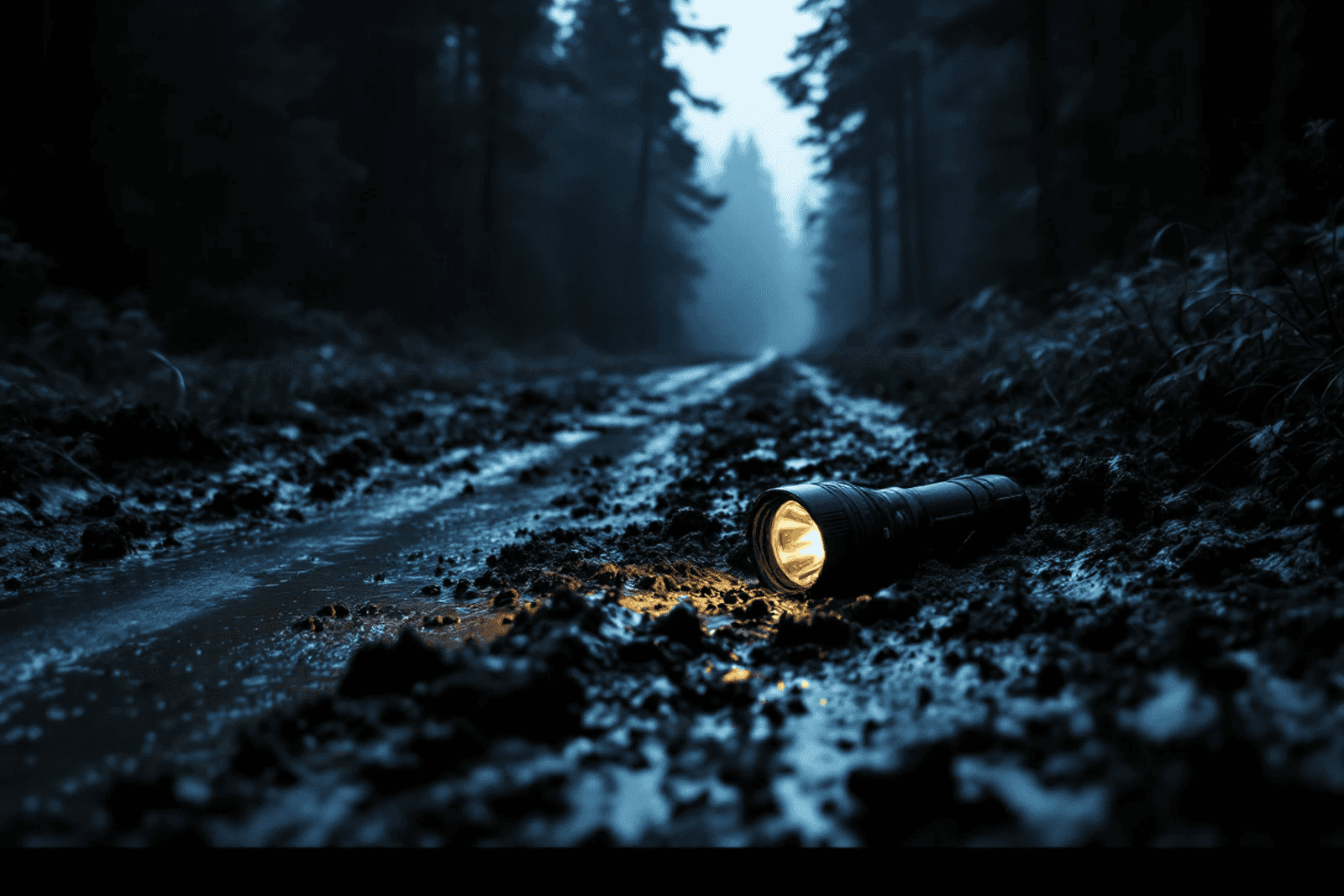
On October 31, 2001, two teenagers walked into the forest near Port Rupert, on the northern end of Vancouver Island, with a VHS camcorder. The camera came back. Matthew Nichols and his best friend Jordan Reimer did not.
None of that happened. Hunting Matthew Nichols (2024) is a scripted Canadian horror film dressed as a true-crime documentary, and the boys, their families and the town are invented. The film’s official website says so in its footer: “The content on this website is entirely fictional and created for entertainment purposes.” Port Rupert is not on any map. We searched for a real case under these names and found no record of one, which is a search result, not proof.
The case the film invents
The story the film tells is a cold case reopened. In 2023, Matthew’s younger sister Tara, a documentary maker played by Miranda MacDougall, hires a director and a cinematographer to look at it again. The director is Markian Tarasiuk, playing a version of himself. The cinematographer is Ryan Alexander McDonald, also under his own name. The Rotten Tomatoes synopsis says the crew goes further “when an unsettling piece of evidence is revealed,” and several synopses say Tara comes to believe her brother “might still be alive.”
The synopses say the boys vanished “two decades” earlier. Count from 2001 to 2023 and it is twenty-two years. A small thing, and the kind of seam a real case file would not have.
Where Port Rupert is
Nowhere. Tarasiuk explained the name to HNMAG in December 2024: “‘Port Rupert’ is a fictional town based on that town. … We named it on purpose because it’s a mixture of Port Hardy and Prince Rupert.” Port Hardy is real and sits on northern Vancouver Island. Prince Rupert is real and sits on the British Columbia mainland coast, across the water. Port Rupert exists only between them, in the film.
Did a Matthew Nichols really go missing?
Not this one. We searched both names with “Vancouver Island,” “2001” and “missing,” and every result was about the film. Matthew Nichols is a common name, so the honest sentence is narrow: the Matthew Nichols in this film is fictional, and so is Jordan Reimer.
The setting, though, was chosen with intent. “The Island is the movie and the movie is the Island for this one,” Tarasiuk told the Georgia Straight. He has said the film grew from “our cultural fascination with true crime, especially missing persons cases,” and from forest-creature stories told to children: “It was created in the day to keep kids from running away into the forest and getting lost.”
From a gray island to 900 screens
Tarasiuk is a Vancouver actor who calls himself “very much from the Hallmark world, because that’s what Vancouver offers to actors.” When he went looking for money, he told the Georgia Straight, “everybody in the city passed.” The film was made for $275,000 in twelve days. “We went forward in December on Vancouver Island because it was gray, raining, and dark,” he told Screen Geek.
It premiered at the Newport Beach Film Festival on October 19, 2024. On the 2024 festival circuit it was nominated for Best Canadian Feature at Whistler, Tarasiuk won Best Director at Blood in the Snow, and FilmQuest gave it Best Found Footage Feature and Best Editing for Jonathan Mathew.
Steven Soderbergh called it “a sneaky, simmering take on the true crime folk horror genre that boils over and becomes truly unnerving,” as Fangoria reported on April 1, 2026. “I was blown away that he watched it and said what he said,” Tarasiuk said later.
It opened across North America on April 10, 2026, on what the Georgia Straight counted as “over 900 theatres across North America.” Box Office Mojo records $710,532. On Rotten Tomatoes, as of October 15, 2026, critics give it 89% from 18 reviews and audiences 47%, a split worth noticing in a film whose whole trick is the first act. Shudder’s Season of Screams schedule lists it for October 31 as a Shudder Exclusive Film, which means licensed, not produced by Shudder.
The marketing that played it straight
The campaign was built to blur the film’s own line. Tarasiuk told Pop Culture Unplugged in March 2026 that “the marketing had to be just as strong and as unique as the film itself,” and that the aim was to “blur the line between reality and fiction as much as possible.” He listed the pieces: “Between the staged feuds, the interactive game, and the missing persons TikToks,” the campaign “has started to take on a life of its own.” We found no description of what the staged feuds were, or who took part.
The game is called The Hunt. Players pick a character path, answer clues to unlock cards and collect nine hidden ones. Among the in-world material is a missing poster for both boys, with ages, descriptions and a last-seen location, branded “Vancouver Island Police.” The game page carries no disclaimer. The disclaimer lives on the main site, in the footer.
Did anyone fall for it? Adam Schoales of That Shelf wrote that the campaign “drew me in hook, line, and sinker.” We found no news report of police or the public treating the case as real. Heaven of Horror, for its part, found the film “honest about being fiction.”
How the format makes you believe
The first act works because it borrows a grammar you already trust. Schoales wrote that it “perfectly replicates the editing rhythms and visual language of Netflix’s true-crime documentaries”: talking heads, archive footage, a recovered VHS tape. Then the film turns, and the crew’s own cameras take over, and the documentary becomes found footage.
If you want the seams, look here:
- The credits. A cast list, not a list of subjects: Christine Willes plays Pam Hamilton, and the co-writer, Sean Harris Oliver, voices the 911 operator.
- The names. The director and cinematographer appear as themselves, the device The Blair Witch Project (1999) made famous. A real name on screen is not a real event.
- The map. Every place you can check is real except the one the case happens in.
- The prizes. FilmQuest named it Best Found Footage Feature, a category built for staged footage.
For how the camera-in-the-room style grew up, see Paranormal Activity and found footage and the three kinds of ghost movie.
Blair Witch, Lake Mungo, Ghostwatch
Tarasiuk names The Blair Witch Project as an influence, and its campaign is the template. Its official site went up in June 1998 with faux police reports. Missing-person flyers for its three students were handed out at festivals including Sundance. IMDb listed the actors as “missing, presumed dead” during the film’s first year, and the Sci-Fi Channel aired the mockumentary Curse of the Blair Witch on July 12, 1999. Of Paranormal Activity (2007), Tarasiuk has said: “I almost hoped it was real, even though I knew it wasn’t.”
Lake Mungo (2008), written and directed by Joel Anderson, is the grief-driven Australian version, a faux documentary about a drowned 16-year-old. “You’d be wondering, is it real, is it not real?” Anderson said.
The older precedent is British television. On October 31, 1992, BBC1 broadcast Ghostwatch, a “live” ghost hunt fronted by real presenters, to around 11 million viewers; tens of thousands called in, and a regulator later ruled against the BBC. The whole story is in Ghostwatch, 1992. For films that do rest on a real case, see ghost movies based on true stories, and for the night itself, ghost movies to watch this Halloween.
What does not fit
Three Halloweens line up. Ghostwatch aired on October 31, 1992. Matthew Nichols vanished, in the story, on October 31, 2001. And on October 31, 2026, the film arrives on Shudder. Meanwhile the poster for two boys who never existed is still up on the game page, with their ages and the place they were last seen, and the sentence that says none of it is real is on another page, in the footer.